Lesson 02 · 90 minutes · 14 parts
Sports
Why sport is a different business from logistics or food: a product that can’t be guaranteed, competitors who have to cooperate, and money from rights, partners, and fans. Judo, Slavia Prague, and HOPI as examples.
What you will take away
- -Explain how the sports product differs from goods and services: uncertain outcome, perishability, co-creation with the audience, essential rivalry.
- -Distinguish the types of sports organizations (federation, club, league, private enterprise, grassroots), their stakeholders, and their motivations.
- -Describe the main revenue streams in sport and assess them by scalability, predictability, and control.
- -Show how technology, streaming, and documentary series are changing both the fan experience and the promotion of sport.
- -Understand the difference between elite and amateur sport, the pathways between them, and the role of the state in the Czech Republic.
Lesson plan
- 5 minIntro and a question for the class · Would you buy a ticket to a match if you already knew the result?
- 5 minStudent presentation · Pick a club or federation you know and show its 4Ps on three slides: what it sells, for how much, where, and how it gets the word out.
- 15 minBlock 1: Why sport is a different business · An uncertain product, values as an asset, the four segments of the sports economy, sport and the world (the Olympics, world championships, politics).
- 21 minBlock 2: Organizations, product, and money · Types of organizations and stakeholders, cooperation between competitors, the 8Ps and the price of the dual objective, revenue streams, tickets, season tickets, and fan data.
- 10 minExercise: a company–sport partnership · Three groups design a HOPI partnership with a club, a federation, and a local event: audience, activation, a plan for the worst case. The brief is on the slide in the Exercise section.
- 17 minBlock 3: Athlete, technology, fan · The athlete as a brand, managing the unpredictable, technology in sport, fan engagement and trends.
- 9 minBlock 4: Pro vs. amateur, USA vs. Europe · Two sports economies, pathways through the pyramid, two systems and two fan cultures.
- 8 minSummary and quiz · Back to the opening question and the checklist (3 min), five quiz questions (5 min), homework.
Contents
- 1Why sport is a different business
- 2The global sports economy: four segments
- 3Sport and the world: the Olympics, world championships, politics
- 4Who runs sport and why rivals have to cooperate
- 5The 8Ps and the price of the dual objective
- 6What sport lives on: revenue streams
- 7Tickets, season tickets, and fan data
- 8Exercise: a company–sport partnership
- 9The athlete as a brand and managing the unpredictable
- 10Technology in sport
- 11Fan engagement and trends in promotion
- 12Pro vs. amateur sport and the pathways between them
- 13USA vs. Europe: two systems, two cultures
- 14Summary: chaos is the asset
1Why sport is a different business
0:00 / 3:46AI clone of Jan Ječmínek’s voice
Why sport is a different business
- ·A product you can’t guarantee: even you don’t know the result
- ·Fans stay even after relegation, and they buy an experience, not a thing
- ·Winning ≠ commercial success: Tottenham 17 years without a trophy, still top 10
- ·Values as an asset: brands borrow fair play and emotion; they can’t make them
- ·In logistics, you fight for margin on predictability; in sport, the chaos is the asset
Sport has customers, a product, a price, and distribution like any business, and yet it differs in everything marketing textbooks take for granted. A detergent maker guarantees that the detergent will get clothes clean. A club can’t guarantee that it will win. That’s the core: uncertainty of outcome isn’t a defect of the product; it is the product itself. If the result were known in advance, nobody would watch.
The second difference is loyalty. A customer whose washing machine lets them down switches to a competitor. A Baník Ostrava fan doesn’t switch to Sparta Prague when Baník is relegated. They stay, because the club is part of their identity, their family, and their town. For a marketer, that’s both a gift and a trap: you have an audience that can’t be poached, but also an audience that can’t be fooled. They know the club better than you do.
Third: you sell an experience, not a thing. The value of a ticket isn’t in the seat but in what happens on the pitch and in the stands. The product only comes into being when the game is played, and it’s created together with the audience. An empty stadium during the pandemic was a different product from a full Eden, Slavia’s stadium.
Fourth: the dual objective. A company optimizes for profit. A club wants to win and to survive at the same time, and the two goals often pull against each other. Some successful brands don’t win: Tottenham went 17 years without a trophy (2008–2025) and stayed in the top 10 of the Deloitte Football Money League the whole time; in the ranking for the 2024/25 season it is ninth with €672.6 million (overview on GOAL). And some winning clubs have gone bankrupt. What the dual objective costs is shown by the numbers for Barcelona and the Premier League in the section on the 8Ps. That’s why the whole lesson revolves around one sentence: in logistics, you fight for margin on predictability; in sport, the chaos is the asset.
Fifth: values as an asset. Fair play, emotion, and competing under the same rules are the whole point of sport, and at the same time goods that brands borrow, because they can’t make them on their own. The IOC sells its TOP partners the Olympic rings and values, not advertising space: the Olympic Charter bans advertising at the venues. Judo has an eight-word moral code: politeness, courage, sincerity, honor, modesty, respect, self-control, friendship. For the federation, it’s a ready-made brand manual that no strategist had to write. The reverse is also true: doping or a fixed match destroys value faster than a losing streak, because it takes away the one thing the product can’t buy: that the game is played for real.
For discussion
Would you buy a ticket to a match if you knew the result in advance? And why not, when it doesn’t bother you that the cinema has already been showing a film for ten weeks?
Rabbit holes
- Soccernomics (Kuper, Szymanski), review of the 2026 edition ↗ · A review of the new edition (HarperCollins 2026): why the wage bill predicts the league table and why clubs survive their losses.
- Deloitte Football Money League 2026 ↗ · The ranking of the 20 richest clubs straight from Deloitte: who makes money even without winning.
- IJF: the judo moral code ↗ · Eight values the international federation sells as the essence of the sport; read it as a brand manual.
2The global sports economy: four segments
0:00 / 2:57AI clone of Jan Ječmínek’s voice
Sport: $400–500 billion and four different businesses
- ·Spectator and professional sport: leagues, clubs, federations, major events
- ·Participatory sport: clubs, fitness, running, cycling, Strava
- ·Sporting goods: Nike and Adidas vs. On, Hoka, Lululemon
- ·Betting and fantasy: $70 billion (2024), heading for $100 billion by 2029
- ·Size: $400–500 billion a year, depending on who counts what
Sport as an industry has no single boundary, and so it has no single number. Statista estimates the size of the global sports industry at roughly $417 billion in 2025; other agencies count over $500 billion, because they add apparel, footwear, betting, or sports tourism. Pick the number that fits your purpose, but always state the definition. For scale: the world’s 20 richest football clubs together brought in €12.4 billion in the 2024/25 season (Deloitte), almost 40 annual budgets of the Czech National Sports Agency, the NSA (CZK 8.2 billion for 2026).
Four segments:
- -Spectator and professional sport: the core of the industry. Leagues, clubs, federations, and major events (NFL, Premier League, the Olympics, the FIFA World Cup) produce content for mass audiences. It lives on media rights, partners, and tickets.
- -Participatory and recreational sport: people who play sport themselves. Amateur clubs, fitness, running races, cycling. The base from which both spectators and professionals grow, and also a market for equipment and apps like Strava.
- -Sporting goods and equipment: apparel, footwear, gear. The big players (Nike, Adidas) are losing momentum to narrowly focused brands (On, Hoka, Lululemon) that build on community and on one product they do best. More in the Brand chapter.
- -Betting and fantasy sports (fantasy: a player builds a virtual team of real athletes and scores points for their performances): one of the fastest-growing segments. Statista estimates the global sports betting market at roughly $70 billion (2024), growing to $100 billion by 2029, about 7% a year. Growth comes mainly from in-play betting, which keeps viewers at the screen until the end.
The Czech Republic isn’t small here. In fixed-odds betting, Czechs wagered CZK 145.2 billion in 2024, a tenth more than the year before (betting operators’ figures via Echo24). That’s roughly CZK 13,000 for every resident, babies included, and almost eighteen times what the state gives to sport each year through the National Sports Agency (CZK 8.2 billion in 2026). That’s why betting companies are among the biggest sponsors of Czech sport: the football league is called the Chance Liga, and the ice hockey Extraliga carries the Tipsport name. Betting partners and the rules for their advertising are covered in the Sponsorship chapter.
The segments overlap. Strava is participation, but it sells data and advertising. A betting company belongs to segment four, but it pays segment one. A good sports marketer knows which segment they stand in and which segment the money flows in from.
- $417 bn
- global sports industry, 2025 estimate
- $70 bn
- global sports betting, 2024 estimate
- CZK 145.2 bn
- fixed-odds bets in the Czech Republic in 2024
- €12.4 bn
- revenue of the 20 richest football clubs, 2024/25
Statista
Statista
betting operators, Echo24
Deloitte Money League 2026
Rabbit holes
- Statista: size of the sports market ↗ · The most cited estimate; it doesn’t state its definition, so compare it with others (over $500 billion when goods and betting are included).
- Echo24: Czechs bet big ↗ · Volumes of fixed-odds betting and slot machines in the Czech Republic in 2024 (in Czech).
3Sport and the world: the Olympics, world championships, politics
0:00 / 2:27AI clone of Jan Ječmínek’s voice
Sport and the world: the biggest stage on the planet
- ·Paris 2024: 5 billion viewers, 84% of the potential audience, 9.5 million tickets
- ·Qatar 2022: 3.4 million spectators in stadiums, 5 billion engaged
- ·ČT sport: 3.74 million Czechs watched the 2024 Hockey World Championship final
- ·Sport is political: boycotts, human rights, the ban on Russia
- ·Paris 2024: ČT sport, with an 18.6% share, the most watched channel in Czechia
No other industry brings so many people to one screen at once. According to an IOC report, roughly 5 billion people followed the Paris 2024 Olympic Games, or 84% of the planet’s potential audience (an estimate from a survey in 18 countries, not a measurement). The organizers sold a record 9.5 million tickets for the Olympics. The 2022 FIFA World Cup in Qatar had 3.4 million spectators in the stadiums, and FIFA reports 5 billion people who engaged with the tournament in some way. EURO 2024 in Germany: 2.7 million spectators in the stadiums and another 6.2 million in the fan zones.
Czech benchmarks: the final of the 2024 Ice Hockey World Championship, Czechia vs. Switzerland, was watched on ČT sport (the sports channel of Czech Television, the public broadcaster) and on its online platform iVysílání by 3.74 million viewers aged 4+, with a 76% share (ČTK, the Czech News Agency, citing ČT). It is the most watched broadcast in the history of ČT sport and Czech Television’s second most watched sports broadcast, after the Nagano 1998 Olympic hockey final, Czech Republic vs. Russia (4.16 million). Three out of every four TVs switched on in the country were showing hockey. Different methodology, different number: ATO-Nielsen, the official Czech TV audience measurement (viewers 15+, TV only), reports a 74.36% share (MediaGuru). During the Paris Olympics, ČT sport, with an 18.6% share, was the most watched channel in the Czech Republic overall, ahead of the commercial channel Nova (MediaGuru).
Reach like that makes sport political. States buy prestige by hosting (Qatar, Saudi Arabia), boycott diplomatically (Beijing 2022), exclude rivals (Russia and Belarus, after February 2022, kept out of most competitions on the IOC’s recommendation, and in Paris only as neutral individual athletes), and use national teams as a symbol of the nation. For a marketer, this means that a partnership with sport is always also a partnership with its controversies. Sponsors of Qatar 2022 had to deal with human rights; the Super League clubs (see below) ran into a revolt by their own fans.
- 3.74 million
- viewers of the 2024 hockey world final on ČT, 76% share
- 84%
- of the potential audience watched the 2024 Olympics (IOC survey estimate)
- 18.6%
- ČT sport’s share during the 2024 Olympics, No. 1 in Czechia
ČT / ČTK
IOC
ATO-Nielsen / MediaGuru
People in the stands: the biggest events of recent years
unit: million
The Olympics sell more tickets in three weeks than the entire F1 season does in a year.
data table
| Paris 2024 Olympics (tickets sold) | 9.5 million | |
|---|---|---|
| Formula 1, 2025 season (attendance) | 6.7 million | |
| FIFA World Cup Qatar 2022 | 3.4 million | |
| EURO 2024 Germany | 2.7 million |
Rabbit holes
- IOC: Paris 2024 and 5 billion viewers ↗ · How the IOC arrived at the number (a survey in 18 countries) and what you can’t read from it.
- FIFA: Qatar 2022 in numbers ↗ · Attendance, viewership by country, and digital reach from FIFA’s annual report.
- UEFA: EURO 2024, the tournament in review ↗ · The final numbers: stadiums, fan zones, transport, social media. How you measure a tournament, not just a match.
- MediaGuru: the 2024 hockey final in ATO-Nielsen numbers ↗ · A 74.36% share among viewers 15+, 0.5 million online, and a comparison with Nagano 1998 at 4.16 million (in Czech).
4Who runs sport and why rivals have to cooperate
0:00 / 4:19AI clone of Jan Ječmínek’s voice
No opponent, no product: a league is a cartel
- ·Federation, club, league, private enterprise, grassroots: five missions
- ·Stakeholders: fans, sponsors, media, athletes, the state
- ·Competitors have to agree on rules, schedules, and rights
- ·Super League 2021: 12 clubs, 48 hours, the end
- ·Governance: members (50+1) vs. investor (Chelsea) vs. league (NFL)
Five types of organizations, five missions, five kinds of marketing:
- -National federation (the Czech Judo Federation; FAČR, the Football Association of the Czech Republic): develops the sport, fields the national team, oversees the rules. Non-profit, governed by its member clubs, dependent on the state and on the international federation (IJF, FIFA; in football, with UEFA in between at the European level). Marketing targets recruiting kids, subsidies, and national pride.
- -Professional club (Slavia Prague, Juventus): competes for trophies and monetizes its fans. It can be member-owned (FC Barcelona, German clubs under the 50+1 rule) or in the hands of an investor (Chelsea, Slavia under Pavel Tykač). Marketing = the entertainment industry.
- -League (NBA, Premier League, and the LFA, which runs the top Czech football leagues): maintains competitive balance, sells media rights centrally, protects integrity. It decides by club vote (Bundesliga) or through a strong central office (NFL).
- -Private sports enterprise (UFC, Red Bull, Formula 1 under Liberty Media): owns both the content and the distribution and treats sport as media entertainment. It optimizes the show and revenue, not fairness.
- -Grassroots and school sport: development, health, access. Subsidized, dependent on volunteers. Marketing = community and recruitment.
Around each of them stand stakeholders with conflicting interests. Fans aren’t just customers; they are watchdogs, critics, and evangelists. Sponsors want visibility and aligned values. Athletes are both employees and celebrities with their own brand. The state subsidizes and regulates, because sport is both prestige and public health. The media pay for rights and want stories in return. Owners want profit, prestige, or influence. Sometimes the motivations line up; often they don’t.
And the most important thing that sets sport apart: competitors have to cooperate. Toyota doesn’t need Volkswagen to sell a car. Slavia needs Sparta to have a derby. A league is effectively a cartel: clubs agree on rules, schedules, the sale of rights, and often on revenue sharing too. Rivalry sells; coordination sustains it. A team that’s too dominant weakens the product: PSG in France, Bayern with eleven titles in a row (2013–2023). American leagues deal with this through salary caps and the draft (the selection of new players, where the worst team picks first); European leagues mostly don’t.
What happens when cooperation is abused was shown by the European Super League in April 2021. Twelve of the richest clubs announced a closed competition with no relegation. Within 48 hours, fans outside the stadiums, players, coaches, UEFA, and the British prime minister had turned against them; the six English clubs backed out, followed by Inter and Atlético, and the project was suspended (Fortune). The lesson for marketers: in sport, it isn’t the owner who decides, but legitimacy among the people who co-create the product.
- 12 clubs
- founded the Super League; the 6 English ones left within 48 hours
- 50+1
- Bundesliga rule: club members hold the majority of votes
Fortune / Bloomberg, 2021
Bundesliga
Rabbit holes
- Fortune: the Super League collapsed in 48 hours ↗ · A Bloomberg report from April 21, 2021: who left first and who really decides in football.
- Bundesliga: the 50+1 rule explained ↗ · Why an investor can’t take control of a club in Germany, and what the exceptions are.
- Czech Judo Federation ↗ · The federation’s website: member registry, club locator, national team (in Czech).
- IJF: World Judo Tour 2025 mid-season review ↗ · What an international federation’s season looks like from the organizer’s point of view.
5The 8Ps and the price of the dual objective
0:00 / 2:17AI clone of Jan Ječmínek’s voice
8Ps: marketing a product you can’t guarantee
- ·4Ps: Product, Price, Place, Promotion
- ·+4Ps: Planning, Packaging, Positioning, Perception
- ·Dual objective: win and survive. Barcelona 2021: €1.35 billion in debt
- ·Premier League 2024/25: wages 65% of revenue, a £948 million loss
- ·Don’t plan the campaign around the result, but around the story
The features of the sports product from the first section (uncertain, perishable, co-created, dependent on the opponent) have a practical consequence: the classic marketing mix isn’t enough. Rivalry sells even without form: El Clásico sells out regardless of the table.
That’s why sports marketing extends the classic 4Ps (more in the Marketing chapter) to 8Ps:
- -Product: the match, the season, the experience, the community, not just 90 minutes.
- -Price: tickets, season tickets, subscriptions, dynamic pricing by opponent.
- -Place: stadium, TV, streaming, social media, fan zone.
- -Promotion: campaigns that must not promise a result.
- -Planning: a plan that accounts for defeat, injury, and scandal.
- -Packaging: how to package the experience: hospitality for partners, family sections, content around the match.
- -Positioning: what makes the club different: tradition, youth, region, style of play.
- -Perception: how fans, media, and sponsors see us. One event off the pitch changes it.
Hanging over all of this is the dual objective: victory vs. viability. Fans reward emotion, not a balanced budget, so clubs overspend. FC Barcelona, one of the strongest brands in the world, was €1.35 billion in debt in March 2021 (ESPN), and in October 2021 a Deloitte audit concluded that the club had been “technically bankrupt” at the time (Front Office Sports). In the 2024/25 season, Premier League clubs spent 65% of their revenue on wages and together lost £948 million before tax, despite record revenue of £6.8 billion (Deloitte). The wage bill correlates with the league table, but it doesn’t guarantee it: Leicester won the league in 2016 with a budget from the bottom half.
For a marketer, only one thing follows: never plan a campaign around the result. Plan around a story that holds up in both victory and defeat. The slogan “Going for the title” after three defeats hurts. “We’re here, for better or worse” always works.
- €1.35 bn
- FC Barcelona’s debt in March 2021
- 65%
- wages as a share of Premier League club revenue, 2024/25
- £948 m
- Premier League clubs’ pre-tax loss, 2024/25
ESPN / Deloitte audit, October 2021
Deloitte ARFF 2026
Deloitte ARFF 2026

Rabbit holes
- ESPN: Laporta and the €1.35 billion debt ↗ · The debt broken down item by item: players, lawsuits, TV advances, the stadium.
- Front Office Sports: the Barcelona audit ↗ · What the Deloitte audit showed in October 2021: in March, the club was technically bankrupt.
- Deloitte ARFF: Premier League clubs ↗ · Revenue, wages, and losses of the world’s richest league, season by season.
6What sport lives on: revenue streams
0:00 / 4:34AI clone of Jan Ječmínek’s voice
The Premier League lives on TV, the Czech top clubs on Europe and transfers
- ·Broadcasting rights: the biggest source at elite level, sold by the league
- ·Partners and sponsorship: scalable, but it needs activation
- ·Tickets and matchday: reliable, but capacity is the ceiling
- ·Merch, prize money, digital memberships, data for betting
- ·Rights: Premier League about CZK 50 billion a year, Chance Liga CZK 430 million
- ·Czech top clubs: UEFA and transfers; other clubs: the owner’s money
Sports organizations combine traditional and new revenue, and each stream has a different risk profile. At the elite level, broadcasting rights rule: Premier League clubs had revenue of £6.8 billion in the 2024/25 season, roughly half of it from TV (chart, Deloitte). The league sold its domestic rights for 2025–2029 to Sky and TNT for a record £6.7 billion, roughly CZK 50 billion a year (Sportcal). The Czech top flight got roughly CZK 430 million a year from its rights tender for 2024–2029 (MediaGuru), about one hundredth. The media side of this is covered in the Media chapter.
The individual streams and their profile (scalable, predictable, controllable):
- -Ticketing and matchday revenue: direct and controllable, but not scalable. The limit is capacity: in the 2024/25 season, Slavia averaged 18,306 spectators (LFA) with a capacity of 19,370, so the club’s management is talking about expanding Eden to 30,000 to 45,000 seats, so far without a date or permits (TN.cz).
- -Sponsorship and partnerships: scalable and fairly predictable, but it requires brand alignment and activation. A partner doesn’t pay for a logo; it pays for access to an audience and for the values it borrows.
- -Media and broadcasting rights: the most scalable, negotiated centrally by the league; the club doesn’t control it. Competition from streamers pushes prices up: Apple pays MLS $2.5 billion over ten years, and Amazon pays roughly a billion dollars a year for Thursday NFL games.
- -European competitions and transfers: the biggest items for the Czech top clubs, but unpredictable. A club that drops out in the qualifiers or doesn’t sell a player has a hole in its budget, and the star of the campaign may leave in August.
- -Merchandising and licensing: global potential, but tied to brand strength and results.
- -Prize money and start fees: crucial in individual sports, completely unpredictable. A judoka without a medal gets no prize money.
- -New sources: digital memberships, data for bookmakers, post-event content, fan tokens (so far more of a marketing tool than a stable income).
The Olympic model shows the top of the pyramid: the IOC took in $7.7 billion in the 2021–2024 cycle, 12% more than in the previous cycle, mostly from broadcasting rights and the TOP partner program, and it distributes 90% back to federations, national committees, and organizers (Sportcal). The opposite end, a star’s individual package, is shown by Messi in the section on the athlete as a brand.
The Czech top clubs live differently from the Premier League. TV brings the whole league more than CZK 430 million a year, split roughly 85 to 15 between the first and second divisions and, in the first division, by final position (Médiář); that works out to about CZK 23 million per first-division club on average. Sparta, meanwhile, got CZK 710.8 million from UEFA alone for the 2024/25 Champions League, more than half of its revenue of roughly CZK 1.3 billion, and ticket sales brought in CZK 233.9 million (Sparta). The second leg is transfers: Slavia earned CZK 565.6 million from transfers and loans in 2023 (E15), and in summer 2025 it sold Malick Diouf to West Ham for a record of roughly €22 million (Seznam Zprávy; the fees come from Transfermarkt, clubs don’t publish them). The other clubs rely mainly on money from an owner or the city.
Through the National Sports Agency, the state mainly supports federations, youth sport, and facilities, not professional clubs. The agency has roughly CZK 8.2 billion for 2026; the Chamber of Deputies, the lower house of parliament, raised the government’s proposal by CZK 800 million for sports facilities and school sport (Czech Ministry of Finance). The football association received CZK 577 million from it in 2024, CZK 228 million of that for talented youth. For a small federation, the subsidy is often its main income, so federation marketing is partly aimed at officials and politicians, not just at fans.
- £6.7 bn
- Premier League domestic TV rights, 2025–2029
- CZK 430 m
- a year for Czech league rights 2024–2029, LFA estimate
- CZK 710.8 m
- Sparta from UEFA for the 2024/25 Champions League, over half of its revenue
- CZK 8.2 bn
- NSA budget for 2026 after the increase in the Chamber of Deputies
Premier League / Sportcal
MediaGuru
AC Sparta Praha
Czech Ministry of Finance
Premier League club revenue 2024/25 (£6.8 billion)
unit: %
- Broadcasting rights50%
- Commercial partners35%
- Ticketing and matchday15%
Half of it comes from TV: that’s why the league negotiates rights centrally and the club doesn’t control them.
data table
| Broadcasting rights | 50% | £3.4 bn |
|---|---|---|
| Commercial partners | 35% | £2.4 bn |
| Ticketing and matchday | 15% | £1.0 bn |

Rabbit holes
- Sportcal: Sky and TNT keep the Premier League rights ↗ · What a rights tender looks like: packages, numbers of matches, who dropped out.
- MediaGuru: O2 TV (Oneplay) to broadcast the league until 2029 ↗ · The Czech tender: CZK 430 million a year, VAR as a condition, a separate betting stream (in Czech).
- Front Office Sports: Apple and MLS for $2.5 billion ↗ · How a streamer buys an entire league for ten years and what it wants in return.
- Sportcal: IOC finances ahead of the presidential election ↗ · $7.7 billion per cycle and how it’s split further.
7Tickets, season tickets, and fan data
0:00 / 3:42AI clone of Jan Ječmínek’s voice
A season ticket is a commitment, a fan is a database
- ·Match categories A to D: price by opponent and date
- ·Season ticket: money before the season and a name in the database
- ·Renewal rate as the main KPI: Brighton 93%, Wolves 94%
- ·One fan ID: ticket, membership, stadium, fan shop
- ·Email only with consent; a child consents alone from age 15
Tickets are the only big revenue stream that club marketing controls on its own, from price to communication. In the 2024/25 season, Sparta Prague took in a record CZK 233.9 million in ticket revenue (Sparta), and average attendance in the Chance Liga, the Czech top flight, was 6,177, the third highest in the history of the independent league (Deník, LFA data). But in the 2025/26 season, stadiums were on average only 61% full, leaving roughly a million empty seats over the season (Football Club). In Czechia, prices follow match categories: Sparta has four categories, A to D, and single tickets cost between CZK 350 and CZK 1,200 depending on the opponent and the date (sparta.cz). Dynamic, demand-based pricing like FIFA used at the 2026 World Cup isn’t documented at any Czech club; clubs stick to a price list announced before the season.
For a club, a season ticket is more than a discount for loyal fans. The money arrives before the season, when the club needs cash most, and with every season ticket the club gets a name, a contact, and an attendance history. The top clubs sell out: for the 2025/26 season, Sparta had 10,000 season tickets and more than 29,000 people on the waiting list, Slavia almost 12,000 and another 12,000 waiting, and Baník Ostrava 9,500, 1,800 more than a year earlier (Forbes CZ). The main indicator is the renewal rate: how many holders buy their season ticket again. Czech clubs don’t publish it; in the Premier League, Brighton reports 93% and Wolves 94% (2025). Clubs steer renewals with rules: Slavia takes away the right of first refusal from anyone who misses two matches without releasing the seat, and the order on the waiting list is set by purchase history (slavia.cz).
The ticket turns into one fan ID. SPARTA iD links ticket purchases, membership, stadium entry, food and drink, and the fan shop; tickets exist only in the app, and points in SPARTA iD set the order on the season ticket waiting list (Marketing & Media). The Sparta UNLIMITED membership, from CZK 149 a month, had more than 10,000 subscribers two months after its 2024 launch (sparta.cz). The data lets you build segments: the core, occasional fans, families, and companies, with a different offer for each. Three indicators are worth tracking: the number of active fans in the database, the renewal rate, and spending per fan per season. For a sense of scale: a Premier League fan spends an average of £138 on matchday without the ticket, £8.90 of it on food and drink inside the stadium (Barclays, 2026).
Fan data comes with rules. A club may send marketing by email or SMS only with consent; the exception covers its own customers and similar products, and every message must offer an easy way to unsubscribe (Czech Act No. 480/2004, Section 7). A child can give consent alone only from age 15 (Czech Act No. 110/2019, Section 7); for younger children, a parent decides. And not everything technology can do is allowed: according to a 2026 opinion of the Czech data protection authority, ÚOOÚ, issued after a Slavia derby, facial recognition of fans isn’t permissible without a specific law (Česká justice).
- CZK 233.9 m
- Sparta’s ticket revenue in 2024/25, a club record
- 29,000
- people on Sparta’s season ticket waiting list for 2025/26
- 93–94%
- season ticket renewal at Brighton and Wolves in 2025
- 61%
- average stadium occupancy in the Chance Liga 2025/26
AC Sparta Praha
Forbes CZ
the clubs
Football Club
For discussion
Your club has 2,000 season ticket holders, and renewal has dropped from 85% to 70%. What do you find out first, and from what data?
Rabbit holes
- Forbes CZ: Queues for loyalty (in Czech) ↗ · Season tickets and waiting lists at Sparta, Slavia, Plzeň, and Baník, and how clubs allocate them.
- AC Sparta Praha: Financial results 2024/2025 (in Czech) ↗ · Tickets, advertising, UEFA, and transfers in one table from the club.
- Slavia: season ticket rules (in Czech) ↗ · The two-strikes rule, a waiting list based on purchase history, and sales only in the app.
- ÚOOÚ: Sending commercial communications (in Czech) ↗ · When you may send a newsletter and what it must contain.
8Exercise: a company–sport partnership
0:00 / 1:30AI clone of Jan Ječmínek’s voice
Exercise: would HOPI sign this partnership?
- ·Group A: a top-flight club. B: a sports federation. C: a local event
- ·1. Who will we reach: customers, employees, or the region?
- ·2. What do we get besides a logo: tickets, hospitality, content, recruitment?
- ·3. What will we do if it goes wrong: injury, scandal, relegation?
- ·5 min in groups, 1 min presentation per group, 2 min evaluation
Now you’ll try it yourselves. The company is HOPI: logistics and food; its customers are other companies (B2B), and its employees work in warehouses and transport. Three model partnership offers have landed on the table, and each group gets one:
- -Group A, a top-flight club: logo on the advertising boards, a box for home matches, posts on the club’s social media.
- -Group B, a sports federation (judo, for example): a national team partnership, content from international tournaments, events for employees’ children.
- -Group C, a local event: a charity run or a tournament in the town where the company has a warehouse: race bibs, a booth, employee teams.
Each group’s output is one slide: three answers and one sentence on why HOPI should or shouldn’t sign it. Does the proposal measure anything other than logo impressions? Does the plan for the worst case have concrete steps (who, what, by when), or just “we’ll deal with it”?
A hint on audience: there are few corporate customers in B2B logistics, and most of them don’t sit in the stadium; employees number in the thousands (HOPI Logistics has some 3,000, the whole HOPI group 4,500), and the region around the warehouse is a neighbor the company lives with. A hint on activation: tickets for employees, hospitality for clients, content for social media, a recruitment channel. A partnership without activation is a gift, not marketing.
9The athlete as a brand and managing the unpredictable
0:00 / 3:42AI clone of Jan Ječmínek’s voice
The athlete as a brand
- ·Ronaldo: 679 million followers, more than any club in the world
- ·The player is performer and product: behavior = brand exposure
- ·Crises are normal: defeat, injury, scandal, a badly timed campaign
- ·Marketing has to be reactive: a plan for winning and losing, a response within an hour
- ·Media training and PR for athletes = protecting value
Athletes aren’t just performance; they are brands. Cristiano Ronaldo has roughly 679 million followers on Instagram (September 2026, list of the most-followed accounts), more than any club, league, or sports brand in the world, and 62 times the population of the Czech Republic. Lionel Messi has about 517 million. For a sponsor, an athlete is a channel with a reach the club doesn’t have. For the club, it’s a risk: the player leaves, and the audience leaves with him.
The athlete is both performer and product. Their form, image, and behavior off the pitch directly determine the brand value of the club and its partners. One tweet, one photo from a bar, one positive doping test, and a campaign worth millions is useless. That’s why clubs and federations invest in media training, monitor social media, and have crisis scenarios ready. An athlete’s behavior is brand exposure that can’t be switched off. How a personal brand is built is covered in the Brand chapter.
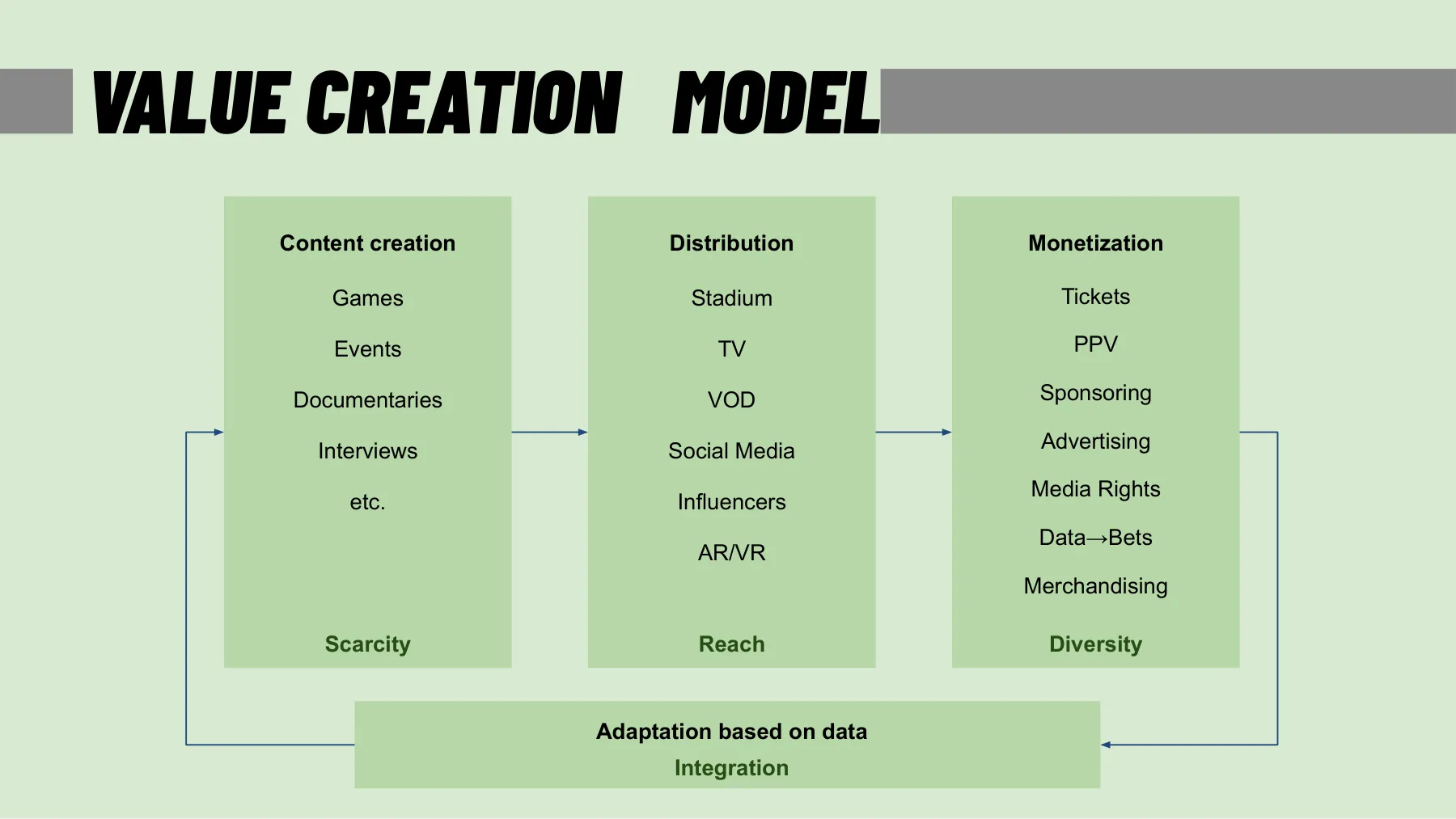
An unpredictable product calls for reactive marketing. Injuries, form, weather, referees: you control none of it. So the plan has to have versions for winning and losing, content that goes out within an hour, and people with the authority to decide without an approval loop. The value creation model in the image sums it up: content, distribution (stadium, TV, video on demand, social media), monetization (tickets, pay-per-view, partners, rights, data), and adaptation based on data. The loop turns every week. And a win is the cheapest marketing there is, but only if you have content ready for it.
- 679 million
- Ronaldo’s Instagram followers, September 2026
- 517 million
- Messi’s Instagram followers, September 2026
- $20.45 m
- Messi’s guaranteed MLS salary in 2025, excluding Apple and Adidas
Wikipedia, list of accounts
Wikipedia, list of accounts
MLSPA / ESPN
For discussion
Which Czech athlete has a bigger brand today than the club or federation they compete for? And who benefits more from it?
Rabbit holes
- The most-followed accounts on Instagram ↗ · A continuously updated list: athletes vs. singers vs. brands.
- ESPN: how much Messi earns in MLS ↗ · What’s in the guaranteed salary and what’s outside it (Apple, Adidas, a stake in the club).
10Technology in sport
0:00 / 3:22AI clone of Jan Ječmínek’s voice
Technology changes how much of the product you capture, not its essence
- ·Officiating: VAR, Hawk-Eye, semi-automated offside (dozens of cameras)
- ·Performance: GPS vests, sensors, video analysis, sleep and load
- ·Fans: Strava 200 million+, club apps, second screen, AR
- ·Broadcasting: drones, 4K, automated highlights, AI commentary
- ·Data = a new revenue stream: betting, personalization, scouting
Technology is changing sport on four levels:
- -Officiating: Hawk-Eye in tennis, goal-line technology, VAR, and since April 12, 2025, semi-automated offside in the Premier League: dozens of cameras track the players and draw the offside line without a human hand (NBC Sports). Fairer play, but also new content: waiting for the verdict is a dramatic device.
- -Performance and health: GPS vests, heart rate sensors, sleep and load analysis, video breakdown of every play. The coach knows how many meters a player covered at sprint speed and when the injury risk is rising.
- -Fans: club apps, real-time tracking, second screen, in-play betting, AR filters, fan tokens. Participatory sport has its own network: Strava, with more than 200 million users in more than 185 countries (Strava), where a workout has become content and kudos a like.
- -Broadcasting and content: drones, cameras in the goal, 4K, automated highlights minutes after the final whistle, personalized streams. IBM has been Wimbledon’s technology partner for 36 years (IBM), and since 2023 it has been generating AI commentary for highlights (TechRadar).
The fifth level is a quiet one: data as a product. Official league data is bought by bookmakers, the media, and game developers. A league that doesn’t sell its data is leaving money on the table. For small sports, this is an opportunity: the IJF publishes results, rankings, and match videos you can build your own service from.
But technology doesn’t change the essence: the uncertain outcome remains. It only changes how much of the product you can capture, distribute, and sell. How this kind of content is produced is covered in the Streaming chapter.
- 200 million+
- Strava users in more than 185 countries
- April 12, 2025
- start of semi-automated offside in the Premier League (Genius Sports)
- 36 years
- of IBM as Wimbledon’s technology partner
Strava, 2026
Premier League / NBC Sports
IBM, January 2026
Rabbit holes
- NBC Sports: semi-automated offside in the Premier League ↗ · How the system works, when it was introduced, and who developed it (Genius Sports).
- IBM: renewed partnership with Wimbledon ↗ · A press release from January 2026: 36 years of cooperation and what IBM supplies to the tournament.
- Strava Year in Sport 2025 ↗ · The annual review for 2025: 180 million people, 14 billion kudos, participation as a network.
- IJF: International Judo Federation ↗ · Results, rankings, video of every match: the data source for the Judo velín.
11Fan engagement and trends in promotion
0:00 / 3:11AI clone of Jan Ječmínek’s voice
Fan engagement: how sport is sold today
- ·Documentary as marketing: Drive to Survive, Welcome to Wrexham
- ·Streamers are buying sport: Netflix, Amazon, Apple, DAZN
- ·Women’s sport: $2.35 billion in 2025, a quarter more than in 2024
- ·The fan as creator: TikTok, content creators, second screen
- ·Czechia: derby on Oneplay 656,000, league viewership +23%
The biggest shift of the last ten years: the fan comes in through the story, not through the result. The Netflix series Formula 1: Drive to Survive (since 2019) is the textbook example. In 2025, Formula 1 had record attendance of 6.7 million people and an average of 1.32 million viewers on ESPN in the US (in 2018 it was 554,000), and the number of partners grew from 12 (2020) to 31 (BlackBook Motorsport). The series itself doesn’t create race viewers; it creates fans of the drivers, and they then watch.
Welcome to Wrexham is the same thing on a small scale. The Welsh club was bought in 2021 by actors Ryan Reynolds and Rob McElhenney; since then it has been promoted three times, average attendance has grown from 4,058 (2019/20) to 12,781 (2024/25), and revenue has reached a record £33.3 million, 58% of it from abroad (annual report). The club itself writes that the series brings it no direct income, but that it is a unique international marketing platform. Be careful with causality: the chart also rises with promotions and stadium capacity, not just with the series.
The second trend: streaming platforms are buying sport, because it’s content that has to be watched live. At Christmas 2024, Netflix aired two NFL games averaging over 30 million viewers per game worldwide (Netflix); Amazon and Apple pay leagues billions (see the section on revenue streams). The third trend: women’s sport. Deloitte estimates the revenue of elite women’s sport in 2025 at $2.35 billion, a quarter more than the year before ($1.88 billion), with basketball and football in the lead. The fourth: the fan as creator. Creators on TikTok and YouTube extend a league’s reach, so leagues open up the stands to them and give them content.
The Czech Republic copies these trends with smaller numbers. Chance Liga viewership on Oneplay rose by 23% in the fall of 2025, the Sparta–Slavia derby was watched by more than 656,000 people, the most in the channel’s history, and average league attendance rose to 6,309 (MediaGuru). Working with social media is covered in the Social Media chapter, and events in the Events chapter.
- 30 million
- average viewers per NFL game on Netflix, Christmas 2024
- $2.35 bn
- revenue of elite women’s sport in 2025, estimate
- 1.32 million
- average F1 viewers on ESPN in 2025, a US record
- 656,000
- viewers of the Sparta–Slavia derby on Oneplay, October 2025
Netflix / Nielsen
Deloitte
ESPN / BlackBook
MediaGuru
Wrexham’s average league attendance
unit: spectators
The Welcome to Wrexham series has been running since 2022; attendance also grew with promotions, and stadium capacity set the ceiling.
data table
| 2019/20 | 4,058 spectators | National League, before the takeover |
|---|---|---|
| 2021/22 | 8,647 spectators | first season under the new owners |
| 2022/23 | 9,973 spectators | series launch, promotion |
| 2023/24 | 11,210 spectators | League Two, promotion; the club’s accounts give 11,229 |
| 2024/25 | 12,781 spectators | League One, promotion; operating capacity limited to 12,800 |
For discussion
Which sport have you started following in the last five years, and what brought you to it: a match, a person, or a series?
Rabbit holes
- BlackBook Motorsport: F1 2025 in numbers ↗ · Record attendance, the US, partners: what a story can do for an elite sport.
- Wrexham AFC: 2024/25 accounts ↗ · Revenue, the share from abroad, a new stand: the numbers behind the series.
- Netflix: NFL at Christmas 2024 ↗ · How a streamer measures sport and why it pays off.
- Deloitte: elite women’s sport 2025 ↗ · $2.35 billion and a breakdown by sport and revenue stream.
12Pro vs. amateur sport and the pathways between them
0:00 / 2:52AI clone of Jan Ječmínek’s voice
Pro vs. amateur: two economies, one pyramid
- ·Elite: media, partners, merch. Grassroots: subsidies, membership fees, volunteers
- ·Inverted costs: the elite pays athletes, the grassroots lives on volunteers
- ·Pathways: 1.4% of NCAA players make it to the NFL, 1.0% to the NBA
- ·Czechia: ČUS registers over 1 million people in 7,378 clubs and 79 federations
- ·Grassroots marketing = recruitment and community, not monetization
Elite and amateur sport are two economies. The elite lives on media, partners, and a global brand; the grassroots on subsidies, membership fees, local sponsors, and volunteers. The costs are inverted: the elite pays its athletes, while the grassroots rests on people who work for free. A typical village football club relies on coaches who are also the players’ parents, and on a pitch that belongs to the municipality.
The pathways are narrow even where the system is set up best. The American NCAA calculates every year how many college athletes end up in a professional league: in hockey 7.5% (with a caveat, see the chart), in baseball 4.9%, in American football 1.4% (257 of 18,621 players eligible for the 2025 draft), in men’s basketball 1.0%. And that’s only the second step: from high school football, 8.1% make a college roster. So out of a thousand high schoolers in helmets, roughly one plays in the NFL. The lower in the pyramid, the more marketing shifts from monetization to recruitment and retention.
The Czech Republic: the Czech Sports Union (ČUS) registers over 1 million people in 7,378 sports associations and clubs, 14,036 club sections, and 79 federations. State money through the National Sports Agency (its budget is in the section on revenue streams) goes mostly down the pyramid, not to the elite: to clubs, youth, and infrastructure. For a federation marketer, this means a dual audience: the parents who bring their child, and the state, which pays for the sports hall.
Between the two worlds, a third one is growing: products where professionals sell to amateurs. Camps with national team athletes, running races with the elite at the front of the field, Strava challenges with a professional team. The value is in proximity: the amateur buys a piece of the elite.
- 1 million+
- people registered in the Czech Sports Union
- 7,378
- sports associations and clubs in ČUS
- 79
- sports federations that are members of ČUS
ČUS
ČUS
ČUS
From college sport to a professional league (NCAA)
unit: %
Even in the world’s most professionalized system, no more than a few percent make it.
data table
| Ice hockey (NHL 2025) | 7.5% | includes committed recruits; the NCAA lists it as not comparable |
|---|---|---|
| Baseball (MLB 2025) | 4.9% | |
| American football (NFL 2025) | 1.4% | |
| Men’s basketball (NBA 2024) | 1% | |
| Women’s basketball (WNBA 2024) | 0.8% |
For discussion
How many of you did sport competitively? Why did you stop: injury, school, money, or was there no one to keep you in it? What can a club’s marketing do about that?
Rabbit holes
- NCAA: the probability of a professional career ↗ · The funnel from high school → college → pro league, sport by sport.
- Czech Sports Union ↗ · The largest umbrella organization in Czech sport: clubs, sections, and federations in numbers (in Czech).
- Czech Ministry of Finance: the 2026 state budget and the NSA ↗ · How much the state gives to sport and where the Chamber of Deputies moved the money (in Czech).
- Judo Heroes ↗ · A summer camp for judokas aged 9 to 15 with coaches who have national team experience: program, capacity, photos (in Czech).
13USA vs. Europe: two systems, two cultures
0:00 / 1:47AI clone of Jan Ječmínek’s voice
The US sells a show, Europe sells identity
- ·USA: closed leagues, no relegation, the franchise as an entertainment company
- ·Europe: open pyramid, promotion and relegation, risk and identity
- ·USA: salary cap (NFL $279.2 million), draft, revenue sharing = parity
- ·Europe: market-driven transfers, 50+1, member-owned clubs
- ·Fans: consumer and show vs. guardian of tradition and the ultras
American and European sport rest on opposite principles. USA: closed leagues with no promotion or relegation, franchises run like entertainment companies, and the league maintains parity with tools a European club would never accept: a salary cap (NFL 2025: $279.2 million per team, NFL), the draft, and equal sharing of TV revenue. The result: every team has a chance, and franchise values rise over the long term.
Europe: an open pyramid where relegation is real and painful. Transfers are market-driven, clubs are autonomous, the risks are higher, but identity is stronger. Germany protects its clubs with the 50+1 rule (see the section on organizations): an investor can have money, not control. Barcelona and Real Madrid belong to their members. The result is generational loyalty, which in the US is replaced by the show.
Fan culture differs just as much. An American game: halftime show, family entertainment, sponsors on the field, the fan as consumer. A European derby: pyro, chants, choreos, politics on banners, the fan as guardian of tradition. Marketing has to reflect these roots: a polished, inclusive tone in the US, a tribal, emotional one in Europe. That’s why the Super League fell: an American model in a European culture.
What to take from this in the Czech Republic: our league is European in structure, but with a market of 10.9 million people it is closer in size to a single American metro area. That’s why clubs learn from both: tradition and the ultras from Europe, hospitality, data, and a family experience from the US.
- $279.2 m
- NFL salary cap per team, 2025
- 3 of 20
- Premier League clubs are relegated every year
- 10.9 million
- people in the Czech Republic: a market the size of one US metro area
NFL
Premier League
Czech Statistical Office, 2025
Rabbit holes
- NFL: the 2025 salary cap ↗ · The league’s announcement from February 2025: $279.2 million per team and how the cap grows with revenue.
14Summary: chaos is the asset
0:00 / 1:13AI clone of Jan Ječmínek’s voice
Summary: chaos is the asset
- ·The product can’t be guaranteed: plan around the story, not the result
- ·Rivals cooperate; fans decide on legitimacy
- ·Money: rights, partners, tickets, the state; each stream a different risk
- ·Technology and stories bring in new fans
- ·Grassroots and elite: two economies, one pyramid
Sport is the only business where customers pay for not knowing what they’ll get, and come back even when they got little. Everything else in this lesson follows from that: rivals who have to cooperate, brands that borrow values, and marketing that has to be ready for any result.
A sports marketer’s checklist:
- -Does the campaign hold up in both victory and defeat? If not, rewrite it.
- -Do you know who your number one stakeholder is this week: the fan, the partner, the state, or the player?
- -Do you have a reactive plan: content within an hour, and who decides without approvals?
- -Which revenue stream do you live on, and what’s its profile: scalable, predictable, controllable?
- -Does the partnership have activation, or is it just a logo on the boards?
- -You have data on results and fans; are you showing it anywhere?
- -Grassroots or elite: are you selling monetization or recruitment?
Homework: pick a club, a federation, or an athlete and write three short campaigns: after a win, after a loss, and after a scandal. Same brand, same values, three moods. How to build campaigns like these is something we’ll cover in the Advertising chapter.
For the exam
Terms
- -Uncertainty of outcome: nobody can guarantee the result, and that is the product itself; if the result were known in advance, nobody would watch.
- -Dual objective: a club wants to win and to survive at the same time (victory vs. viability), and the two goals often pull against each other.
- -Rivals cooperating: a league is effectively a cartel in which clubs agree on rules, schedules, and the sale of rights, because rivalry sells and coordination sustains it.
- -Revenue stream profile: assess each stream by scalability, predictability, and control; ticketing is controllable but not scalable, media rights the opposite.
- -Grassroots: amateur sport that lives on subsidies, membership fees, and volunteers, where marketing shifts from monetization to recruitment and retention.
Numbers
- -CZK 145.2 billion: wagered by Czechs in fixed-odds betting in 2024, almost 18 times what the state gives to sport (betting operators, Echo24)
- -CZK 8.2 billion: the National Sports Agency’s budget for 2026 (Czech Ministry of Finance)
- -50%: of Premier League club revenue in the 2024/25 season comes from broadcasting rights (Deloitte)
The final exam is online in the last lesson, in English: 30 questions with three options each from the whole course, and you need 80% to pass. It asks about the terms in the For the exam boxes and how to apply them, much like the quizzes at the end of each lesson.
Final quiz
1A club launches a summer campaign for season tickets. According to the lesson, which slogan is the safest?
- a)“This year we go for the title. Be there!”
- b)“For better or worse. Be there!”
- c)“We’ll beat our rivals in the derby. Be there!”
answer
b) “For better or worse. Be there!”Nobody can guarantee the result, so you plan a campaign not around the result but around a story that holds up in both victory and defeat (section 5)2Bayern won eleven titles in a row (2013–2023). According to the lesson, why is that bad news for the league itself?
- a)Without uncertain outcomes, the league’s product weakens
- b)Dominance breaks the 50+1 rule, and the league faces penalties
- c)Rival fans will leave, since loyalty depends on winning
answer
a) Without uncertain outcomes, the league’s product weakensRivalry and an uncertain outcome are the product, which is why competitors have to cooperate and a team that’s too dominant weakens the product (section 4)3A club’s stadium is 95% full on average, and it wants to earn more. What’s true of its ticketing revenue?
- a)The club doesn’t control it; the league negotiates it centrally
- b)It’s completely unpredictable, like a judoka’s prize money
- c)It hits a ceiling set by the stadium’s capacity
answer
c) It hits a ceiling set by the stadium’s capacityTicketing is direct and controllable but not scalable revenue, and its limit is the stadium’s capacity (section 6)4A federation is considering a documentary series about its national team. Based on the F1 and Wrexham examples, what can it realistically expect?
- a)Direct licensing income that covers the federation’s budget
- b)Fans of the athletes, who then start watching the events
- c)New broadcast viewers, even if nobody knows the athletes
answer
b) Fans of the athletes, who then start watching the eventsAccording to the lesson, a series doesn’t directly create race viewers but fans of the drivers, who then watch, and it brings Wrexham no direct income (section 11)5A small federation lives mainly on a state subsidy through the National Sports Agency and on membership fees. Whom should its marketing target?
- a)Parents, and the state that pays for the hall
- b)Mainly the TV channels that buy broadcasting rights
- c)Mainly the fans who buy tickets and merch
answer
a) Parents, and the state that pays for the hallLower in the pyramid, marketing shifts from monetization to recruitment, and a federation marketer has a dual audience: the parents who bring their child and the state, which pays for the sports hall (section 12)
For next time
Student presentation at the start of lesson 03 Media
Pick one sports news story from the past week and show everywhere it appeared (web, TV, social media, podcasts) and who had it first.
5 minutes, one student or a pair, three slides at most or a phone on the projector
Sources worth clicking
- 1Deloitte Football Money League 2026 ↗ · Revenue of the world’s 20 richest clubs for the 2024/25 season straight from Deloitte; who makes money even without winning.
- 2Deloitte Annual Review of Football Finance: Premier League ↗ · Revenue structure, wages, and losses of Premier League clubs; the primary source for the chart in this lesson.
- 3NCAA: the probability of a professional career ↗ · A table of how many college athletes end up in a professional league, sport by sport.
- 4IOC: Paris 2024 audience report ↗ · 5 billion, 84%, 28.7 billion hours: how the world’s biggest event is measured.
- 5Premier League: domestic rights 2025–2029 for £6.7 billion ↗ · How the packages were split between Sky and TNT, and why Amazon dropped out.
- 6ČTK: 3.74 million people watched the 2024 hockey world final ↗ · 3.74 million viewers, a 76% share, and a comparison with Nagano 1998: a Czech benchmark for the reach of sport (in Czech).
- 7BlackBook Motorsport: F1 2025 in numbers ↗ · Attendance, US viewership, partners: what the story did for Formula 1.
- 8Fortune (Bloomberg): how the Super League collapsed in 48 hours ↗ · A timeline of the two days when fans, players, and politicians steamrolled twelve of the richest clubs.
- 9Deloitte: elite women’s sport 2025 ↗ · A press release with the $2.35 billion estimate and a breakdown by sport and revenue source.
- 10Soccernomics (Simon Kuper, Stefan Szymanski) ↗ · A book on the economics of football: wages, transfers, why clubs don’t go bust. The link goes to a review of the new 2026 edition (HarperCollins).
Rabbit holes
- Formula 1: Drive to Survive ↗ · The series that turned drivers into characters and America into an F1 market.
- Welcome to Wrexham ↗ · Two actors bought a fifth-tier club and made a series out of it.
- Wrexham AFC: 2024/25 annual report ↗ · 58% of revenue from abroad: what the series brought the club and what it didn’t.
- ESPN: Barcelona’s €1.35 billion debt ↗ · How one of the world’s strongest brands ended up on the brink of bankruptcy.
- TechRadar: IBM at Wimbledon 2025 ↗ · Match Chat and AI commentary: technology at the most traditional tournament.
- MediaGuru: Chance Liga viewership on Oneplay ↗ · The Czech league is growing: a record derby, higher viewership and attendance (in Czech).
- Statista: the world sports market ↗ · The baseline estimate of $417 billion; it doesn’t state its market definition, so compare with care.
- GOAL: Money League 2026 club by club ↗ · The full ranking with each club’s revenue, including Tottenham in 9th place.