Lesson 13 · 90 minutes · 13 parts
Psychology
How people really decide: fast and slow thinking, attention, seven principles of persuasion, pricing biases, personality typologies, group influence, appearance, reputation, and AI that persuades better than a human.
This lesson has no English narration yet. The Czech version is narrated.
What you will take away
- -Explain the difference between System 1 and System 2 and recognize which one your message speaks to.
- -Apply Cialdini’s seven principles to a specific product and know where persuasion ends and a dark pattern begins.
- -Spot the anchor, the frame, the decoy and loss aversion in a price list, and know how to write them honestly.
- -Tell what is science in typologies (Big Five) and what is entertainment (MBTI, temperaments), and how to build personas from it.
- -Calculate how much attention you have to work with, explain why variable rewards hook us, and design a website, event or notification accordingly.
- -Work with reputation as social proof over time: reviews, consistency, what a model says about you.
Lesson plan
- 5 minIntroduction and a question for the class · How many decisions have you made consciously today? How many times have you picked up your phone? Guesses on the board.
- 5 minStudent presentation · Bring one price list or offer (a gym, an app, flights) and show how it nudges you to buy.
- 12 minFast and slow thinking, attention · Kahneman, anchoring and loss, 47 seconds on a screen, variable rewards, my dashboard as an example of design for System 1.
- 16 minPersuasion and its limits · Cialdini’s seven principles with experiments, pairs look for a principle on a web page (2 minutes), dark patterns from European Commission sweeps, a checklist for honest persuasion.
- 6 minPricing biases · Anchor, frame, decoy, loss.
- 10 minExercise: the gym price list · Pairs rewrite the price list of a fictional gym (a month for CZK 1,200, a year for CZK 9,900, a year with four personal training sessions for CZK 14,900) so it is more effective and still honest. Two pairs read theirs aloud.
- 9 minEmotion, ELM, B2C vs. B2B · Triggers, Maslow, story, two routes to persuasion, the buying group in B2B.
- 8 minTypologies, tribes and trends · MBTI vs. Big Five vs. DISC, personas, reference groups, Dunbar’s number, diffusion of innovations.
- 11 minAppearance, reputation, AI · 100 milliseconds, the halo effect, reviews and trust, a machine that persuades better than a human.
- 8 minSummary and quiz · Back to the honest-persuasion checklist from the Limits part, five questions.
Contents
- 1Why psychology: we decide with feeling, we justify with reason
- 2Thinking, fast and slow: two systems (Kahneman)
- 3Attention: the scarcest resource
- 4Persuasion: Cialdini’s seven principles
- 5Limits: where persuasion ends and manipulation begins
- 6Cognitive biases in prices and copy
- 7Emotion, story and Maslow
- 8ELM and AIDA through the lens of psychology: B2C vs. B2B
- 9Personality typologies: temperaments, MBTI, Big Five, DISC
- 10Sociology: groups, tribes, trends and Dunbar’s number
- 11Appearance and first impressions
- 12Reputation and trust: social proof over time
- 13AI and psychology: a machine that persuades
1Why psychology: we decide with feeling, we justify with reason
Marketing is applied psychology
- ·We decide fast and with feeling; reason supplies the justification afterward
- ·Nobel Prize in Economics for a psychologist: Kahneman, 2002
- ·Influence (Cialdini, 1984): over 5 million copies, now 7 principles
- ·Approach: an experiment with numbers, use in marketing, limits in the EU
- ·Today: thinking, attention, persuasion, prices, types of people, trends, reputation
All the models in this course (AIDA, ELM, STEPPS, archetypes) stand on one foundation: people are not calculators. We decide fast, with feeling and shortcuts; reason comes afterward and writes the justification. Psychology in marketing is not an add-on; it is the bedrock.
That this is science and not just an impression was confirmed in 2002 by the Nobel Prize in Economics for the psychologist Daniel Kahneman (Wikipedia). From the 1970s on, Kahneman and Amos Tversky showed that people break the rules of rational choice predictably, and what is predictable can be used. The second pillar of this lesson is Robert Cialdini: according to Wikipedia, his book Influence (1984) has sold over 5 million copies, and it now contains seven principles of persuasion.
The third pillar is attention: there is little of it, it is broken into pieces shorter than a minute, and every message competes for it. The numbers come in the third part of the lesson.
- 2002
- Nobel Prize in Economics for the psychologist Kahneman
- 5 million+
- copies of Influence since 1984; it now has seven principles
Nobel Foundation
Wikipedia: Robert Cialdini
For discussion
How many decisions have you made today consciously, after thinking them through? And how many did the “autopilot” make: what to wear, where to sit, what to open first on your phone? Guess the ratio, then try to count it for a single hour of the morning.
2Thinking, fast and slow: two systems (Kahneman)
System 1 decides, System 2 justifies it
- ·System 1: fast, automatic, emotional; System 2: slow, lazy, logical
- ·Anchor: the wheel of fortune lands on 10 or 65, and the estimate is then 25% or 45%
- ·A loss hurts about 2× more than an equal gain pleases
- ·WYSIATI: what you see is all there is; System 1 doesn’t miss what’s missing
- ·In fairness: the priming chapter didn’t replicate, and Kahneman admitted it in 2017
Daniel Kahneman summed up forty years of research in the book Thinking, Fast and Slow (2011). He describes the brain as two systems. System 1 is fast, automatic and emotional, and it runs all the time at no cost: it recognizes a face, dodges a car, decides it likes the packaging. System 2 is slow, effortful and logical: it multiplies 17 × 24, compares specs, reads a contract. And it is lazy: when System 1 convinces it that the answer is already there, it just nods it through. Most marketing speaks to System 1 and leaves it to System 2 to justify the decision.
The best-known evidence is anchoring. In 1974, Tversky and Kahneman had people spin a wheel of fortune that was secretly rigged to stop at 10 or 65, and then asked them for the share of African countries in the UN. Those who saw 10 estimated 25% on average; those who saw 65 estimated 45% (overview of the experiments). Dan Ariely repeated the same thing with the last two digits of an American Social Security number: people with higher numbers bid 60 to 120% more in an auction. But experiments where the anchor was obviously random (a die, a number generator) sometimes failed to reproduce the effect.
The second building block is loss aversion from prospect theory (1979): a loss hurts about twice as much as an equal gain pleases (Wikipedia). “You’re losing CZK 500 a month” moves people more than “you’ll save CZK 500 a month.” The third is WYSIATI (what you see is all there is): System 1 builds a story from what is in front of it and doesn’t miss what is absent. One photo of a happy customer beats a statistic nobody showed.
A final word in fairness: part of the book did not hold up. The studies on priming (subtle cues that are supposed to change behavior) in chapter four did not replicate, and in 2017 Kahneman admitted that he had “placed too much faith in underpowered studies.” Anchoring, framing and loss aversion survived replication.
- 25% → 45%
- estimated share of African countries in the UN after an anchor of 10 vs. 65 (1974)
- 2×
- a loss hurts about twice as much as an equal gain pleases
- +60–120%
- higher auction bids after an “anchor” from a Social Security number
- 1 million
- copies of Thinking, Fast and Slow in its first year (2011–2012)
Tversky and Kahneman, Science
prospect theory, 1979
Ariely, Predictably Irrational
Wikipedia
Rabbit holes
- Wikipedia: Thinking, Fast and Slow ↗ · A chapter-by-chapter summary of the book, including the passage on the replication crisis and Kahneman’s 2017 admission.
- Wikipedia: Anchoring effect ↗ · The wheel of fortune, Social Security numbers, Gandhi’s age: an overview of the experiments, including attempts that failed to reproduce the effect.
3Attention: the scarcest resource
Attention doesn’t get longer, it only shifts
- ·47 s on one screen, 186 phone checks a day (US)
- ·Czechs: 143 minutes a day on social media = 36 days a year
- ·Of ~360 ads a day, we notice 150 to 155 (Media Dynamics, US)
- ·Variable reward: every pull-to-refresh of the feed is a slot-machine lever
- ·Design for System 1: one thing, big, right away; the rest goes in a tooltip
Attention is the one input without which no model in this course works: AIDA starts with the letter A. Since 2004, Gloria Mark of UC Irvine has been measuring how long people stay on one screen before they switch; today’s average is 47 seconds, and it keeps getting shorter. A Reviews.org survey (Q4 2025, about 1,000 American adults) counted 186 phone checks a day, one for every five minutes awake, and 45.8% of people consider themselves addicted. In Czechia, according to the AMI Digital Index 2025 (Stem/Mark, 1,010 users over 15), we spend 143 minutes a day on social media, and Gen Z spends 220 minutes. Over a year, that is 870 hours, or 36 full days.
The other side of the equation is supply. In the Advertising lesson, we saw that the famous 5,000 ads a day is an illustration, not a measurement, and that according to Media Dynamics (2014), an American adult encounters about 360 ads a day and notices 150 to 155. Attention works not like a spotlight but like a System 1 filter with three questions: Is it new? Is it for me? Is it a threat? Whatever doesn’t get through, System 2 never sees.
For design, this leads to one rule: one thing, big, right away. A headline of six words or fewer, one visual, one button. On a website, the first screen has to say what this is and what I should do before anyone scrolls. In video, no logo in the first seconds, straight into the action. At an event, blocks of 15 to 20 minutes with a change of format between them, because a room’s attention fluctuates just as it does on a screen. With notifications, every unnecessary one lowers the chance that the recipient opens the next one.
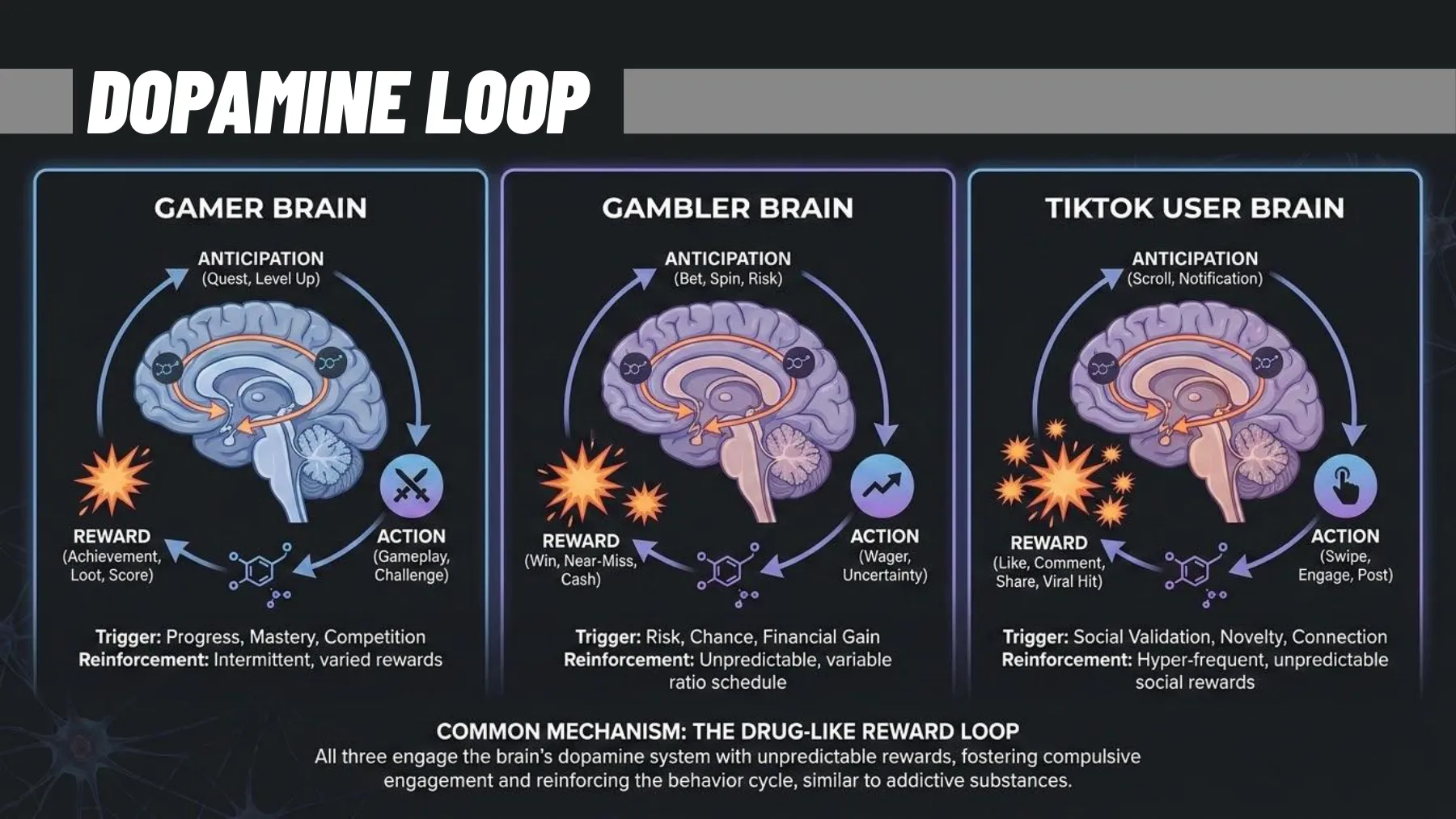
Why do we pick up our phones 186 times a day? The feed pays out rewards irregularly, like a slot machine (B. F. Skinner’s variable ratio), so 186 checks a day are 186 pulls of the lever; we take apart the whole dopamine loop in the Social Media lesson. Marketers use it in streaks and badges; users defend themselves with notification badges turned off, a grayscale screen and the phone kept out of the bedroom. Whoever sells attention should also protect it.
- 47 s
- average attention on one screen before switching
- 186×
- a day an American picks up their phone; 45.8% feel addicted
- 36 days
- a year the average Czech spends on social media (143 min a day)
Gloria Mark, UC Irvine
Reviews.org, Q4 2025
AMI Digital Index 2025, calculation
For discussion
Open your phone’s settings and count how many apps are allowed to send you notifications. How many of today’s notifications were useful? If your brand’s notifications had the same ratio, how long would a customer leave them on?
Rabbit holes
- Gloria Mark: Attention Span ↗ · Twenty years of measuring attention on screens, the book Attention Span (2023) and talks.
- Reviews.org: Cell Phone Addiction Survey ↗ · An annual survey: how often we pick up our phones, how many people feel addicted, the trend.
- AMI Digital Index 2025 (MediaGuru) ↗ · The Czech number: 143 minutes a day, Gen Z 220, and why it isn’t growing (in Czech).
4Persuasion: Cialdini’s seven principles
Seven levers that make people say yes
- ·Reciprocity and commitment: a gift or a small request first (17% → 76%)
- ·Social proof: 74% went along with a wrong majority at least once (Asch)
- ·Scarcity: 2 cookies in a jar taste better than 10
- ·Authority: 65% went up to 450 V because of a man in a lab coat (Milgram)
- ·Liking and unity: we say yes to people we like, and to our own
Robert Cialdini spent three years undercover in sales teams and among fundraisers and recruiters, and wrote Influence (1984) with six principles; in 2016 (Pre-Suasion), he added a seventh, unity, and the 2021 edition has all seven.
Reciprocity: whoever receives something wants to give something back. A sample at the supermarket, a free warehouse analysis, a trial workout, free shipping on the first order. Commitment and consistency: Freedman and Fraser (1966) asked homeowners to put a small “drive safely” sign in their window. When they asked them two weeks later to put a big, ugly sign in their front yard, 76% agreed; without the small request first, only 17% did. Hence loyalty programs and the shopping cart that reminds you of an unfinished purchase.
Social proof: when uncertain, we do what others do. Solomon Asch (1951) seated a person among seven actors who agreed on an obviously wrong line length; 74% of participants went along at least once, and 35.7% of answers were wrong (without the pressure, under 0.7%). The chart shows what a single ally does. Cialdini tested it in hotels: a card saying “most guests reuse their towels” worked better than an appeal to protect the environment, and best of all was “most guests in this room” (Goldstein, Cialdini, Griskevicius 2008). A caveat: a German replication (Bohner and Schlüter 2014, 928 guests) did not confirm the advantage of the norm over the environmental appeal.
Scarcity: Worchel, Lee and Adewole (1975) had people taste cookies from a jar holding either ten or two; the ones from the nearly empty jar tasted better, and best of all were the ones that dwindled from ten to two before people’s eyes. Limited-edition jerseys, “only 3 left,” “sale ends at midnight.” Authority: in Milgram’s experiment (1961, 40 participants), 65% of people “gave” a stranger shocks of up to 450 V because a man in a gray lab coat calmly told them to. “Used by Olympians,” “recommended by 9 out of 10 dentists.” Liking: we say yes to people we like, to people similar to us, to good-looking people, to those who praise us. Unity: it is not that you like me, but that I am one of you. Family, club, “we Slavia Prague fans.” The strongest principle and the hardest to fake.
- -Sports: a free trial workout → a 10-visit pass → “1,200 members train here” → “camp: 8 spots left” → a coach with a medal → community and the jersey.
- -B2B logistics: a free warehouse analysis → a 3-month pilot → client logos → capacity for the season → certifications and a case study → a webinar with a customer.
- -E-commerce: free shipping on the first purchase → an account and points → reviews with photos → “last items” only when it’s true → “verified by customers” → a brand club.
Asch’s experiment: share of people who went along with a wrong majority
unit: %
Three quarters of people denied their own eyes at least once; with an ally who told the truth, 5% still went along with the majority. All bars are shares of participants.
data table
| Unanimous majority: went along at least once | 74% | |
|---|---|---|
| Unanimous majority: never went along | 26% | |
| Majority + 1 ally: still went along | 5% |
For discussion
In pairs, 2 minutes: open one product page on your phone (Nike, the Czech online retailer Alza, a gym) and find at least one of Cialdini’s principles. Is it used truthfully, or would it fail the tests in the next part?
Rabbit holes
- Influence at Work: 7 Principles of Persuasion ↗ · Cialdini’s own page with the principles and short videos; unity added as the seventh.
- Wikipedia: Asch conformity experiments ↗ · Method, numbers, variants of the experiment and criticism.
- Wikipedia: Milgram experiment ↗ · Authority in the lab: 65% up to 450 V, variants and ethical implications.
5Limits: where persuasion ends and manipulation begins
Dark patterns: 148 of 399 online stores (EU sweep, 2022)
- ·Hidden information on 70 sites, false hierarchy on 54, fake countdowns on 42
- ·Black Friday 2025: at least 30% of retailers broke the rules on discounts
- ·Influencers 2023: 97% post commercial content, only 20% consistently label it
- ·Same principle, different truth: “3 left” is either proof or fraud
- ·Test: would it still work if the customer saw how you do it?
Each of the seven principles has a dark twin: a countdown that starts over once it runs out; “Petr from Plzeň just bought this” coming from a script; a subscription you turn on with a click and cancel by letter. These techniques are called dark patterns (a term coined by Harry Brignull in 2010). In 2022, the European Commission, together with authorities from 23 member states, Norway and Iceland, checked 399 online stores: 148 of them (37%) used at least one of the three patterns under review. Most often they hid information (the shipping cost, a cheaper option), then used design to push toward the more expensive choice (false hierarchy), and ran fake countdown timers.
The sweeps continue. Around Black Friday 2025, the Commission checked 314 retailers: at least 30% did not follow the rules for advertising discounts (a discount is calculated from the lowest price in the previous 30 days, not from a fictitious “original” price), 10% used drip pricing (the price grows with fees during checkout), and 18% used pressure techniques. In 2023, a sweep covered 576 influencers: 97% published commercial content, but only 20% consistently labeled it. In Czechia, the same rules are enforced by the ČOI (Czech Trade Inspection Authority), and since 2024 they have been joined by the Digital Services Act (DSA), which explicitly bans dark patterns in platform interfaces.
Where is the line? Two tests. Truthfulness: “only 3 left” is honest scarcity when three are left, and fraud when there are three hundred. Symmetry: saying no must be as easy as saying yes; when “Accept all” is a big green button and “Reject” is a gray link below the fold, that is false hierarchy, even in a cookie banner. A checklist before every campaign:
- -Truth: are there really only 3 left, and does the discount really apply only today?
- -Symmetry: is saying no as easy as saying yes, and canceling as easy as ordering?
- -Discount: is it calculated from the lowest price in the last 30 days?
- -Price: does the customer see the total price before clicking the final step?
- -Transparency: would it still work if the customer saw how we do it?
Dark patterns in 399 online stores: European Commission sweep (2022)
unit: sites
The most common pattern is not the countdown but hidden information: the shipping cost or a cheaper option the customer isn’t meant to see.
data table
| At least one pattern | 148 sites | 37% of 399 |
|---|---|---|
| Hidden information | 70 sites | 23 pushed toward a subscription |
| False hierarchy | 54 sites | |
| Fake countdown | 42 sites |
For discussion
On your phone, find the online store where you last bought something and go through the cart all the way to payment. How many dark patterns do you count (a pre-checked box, a countdown, “today only,” a fee that appears only at the end)? Which of them would you keep if it were true?
Rabbit holes
- European Commission: Sweeps ↗ · All the coordinated sweeps: dark patterns, discounts, influencers, second-hand. The primary numbers.
- Deceptive Design ↗ · A catalog of dark patterns with names, examples and a hall of shame.
6Cognitive biases in prices and copy
Four biases run every price list
- ·Anchor: the first number sets the scale (“originally $200, now $120”)
- ·Frame: “saves 200 people” wins 72%; “400 will die” flips 78% to the risky option
- ·Decoy: Economist 68/32 → with a pointless third option, 16/0/84
- ·Penalty 93% vs. discount 67%: the threat of a loss works better than a reward
- ·Confirmation and availability: we look for what we already believe, and what’s at hand
Cognitive biases are systematic errors of System 1, and four of them drive most pricing. We have already met the anchor: the first number becomes the yardstick, which is why a price list starts with the most expensive enterprise tier, and why a crossed-out price works even if nobody ever paid it (banned in the EU). Framing: Tversky and Kahneman (1981) described an epidemic expected to kill 600 people. A program that “will save 200 people” was chosen by 72% of people over the risky option; described as “400 people will die,” it flipped 78% to the risky option. People rate beef labeled “75% lean” better than the same beef labeled “25% fat” (Levin and Gaeth, 1988). And framing works on experts too: at a conference (Nottingham 2006), 93% of young economists registered on time when the organizers wrote about a $50 “penalty” for late registration, and only 67% when they called the same amount a discount. Senior economists did not respond to the frame (Gächter et al., 2009).
The decoy effect is the most elegant. Dan Ariely showed MIT students a price list from The Economist: web $59, print $125, print + web $125. Nobody chose the middle option, but it changed how they saw the others: 84% chose print + web, 16% web only. Without the decoy, the ratio flipped: 68% web, 32% print + web. A caveat about replications: Yang and Lynn (2014) tried the decoy in 91 variants, and it worked reliably in only 11; it holds mainly where numbers are being compared, which is exactly what happens in a price list. Loss aversion: a trial that expires hurts more than a discount you never got; “you’ll lose the points you’ve collected” works better than “earn points.”
Two biases outside the price list. Confirmation bias: people seek out what they already believe; a fan skips the negative review, and a buyer picks, out of three case studies, the one that confirms what they wanted to buy anyway. Don’t try to convince people they are wrong; give them evidence for what they already believe and attach your product to it. The availability heuristic: what we can easily recall, we consider common; one loud customer on social media looks like a thousand.
- -Price list (fictional gym): Month CZK 1,200 · Year CZK 9,900 · Year + 4 sessions with a coach CZK 14,900.
- -Task (6 minutes): rewrite the order and the copy so they use an anchor, a decoy and a loss frame.
- -Check (2 minutes): for each sentence, write why it is true; cross out the ones that aren’t.
- -Sharing (2 minutes): two pairs read aloud, and the class guesses the anchor and the decoy.
- 72% / 78%
- pick certainty for “saves 200,” risk for “400 will die”; same numbers
- 84%
- chose The Economist’s print + web with the decoy; without it, 32%
- 93% / 67%
- of young economists registered on time with a “penalty” vs. a “discount”
Tversky and Kahneman 1981
Ariely, Predictably Irrational
Gächter et al., 2009
The decoy in The Economist’s price list: share of choices (Ariely)
unit: %
The “print only” option at the same price as “print + web” tempted nobody, but it raised the share of the pricier bundle from 32% to 84%.
data table
| No decoy: web $59 | 68% | |
|---|---|---|
| No decoy: print + web $125 | 32% | |
| With decoy: web $59 | 16% | |
| With decoy: print $125 | 0% | |
| With decoy: print + web $125 | 84% |
For discussion
Is a decoy manipulation when every option is true and can actually be bought? Where would you draw the line in your own price list?
Rabbit holes
- Wikipedia: Framing effect ↗ · The epidemic, lean beef, penalty vs. discount: the original experiments with numbers, and criticism.
- Wikipedia: Decoy effect ↗ · The Economist, popcorn, asymmetric dominance: how a third option changes the choice between two.
- Dan Ariely: Predictably Irrational ↗ · The book behind the Economist experiment and the Social Security number anchor; you’ll read it in one sitting.
7Emotion, story and Maslow
Emotion decides, logic justifies
- ·Six triggers: joy, fear, guilt, pride, belonging, nostalgia
- ·Maslow 1943: five needs in prose; management drew the pyramid later
- ·We remember a story, not specs: Nike Dream Crazy, Coca-Cola at Christmas
- ·High arousal spreads: awe, humor, anger; sadness doesn’t
- ·Binet and Field: emotion builds the brand, rationality sells now
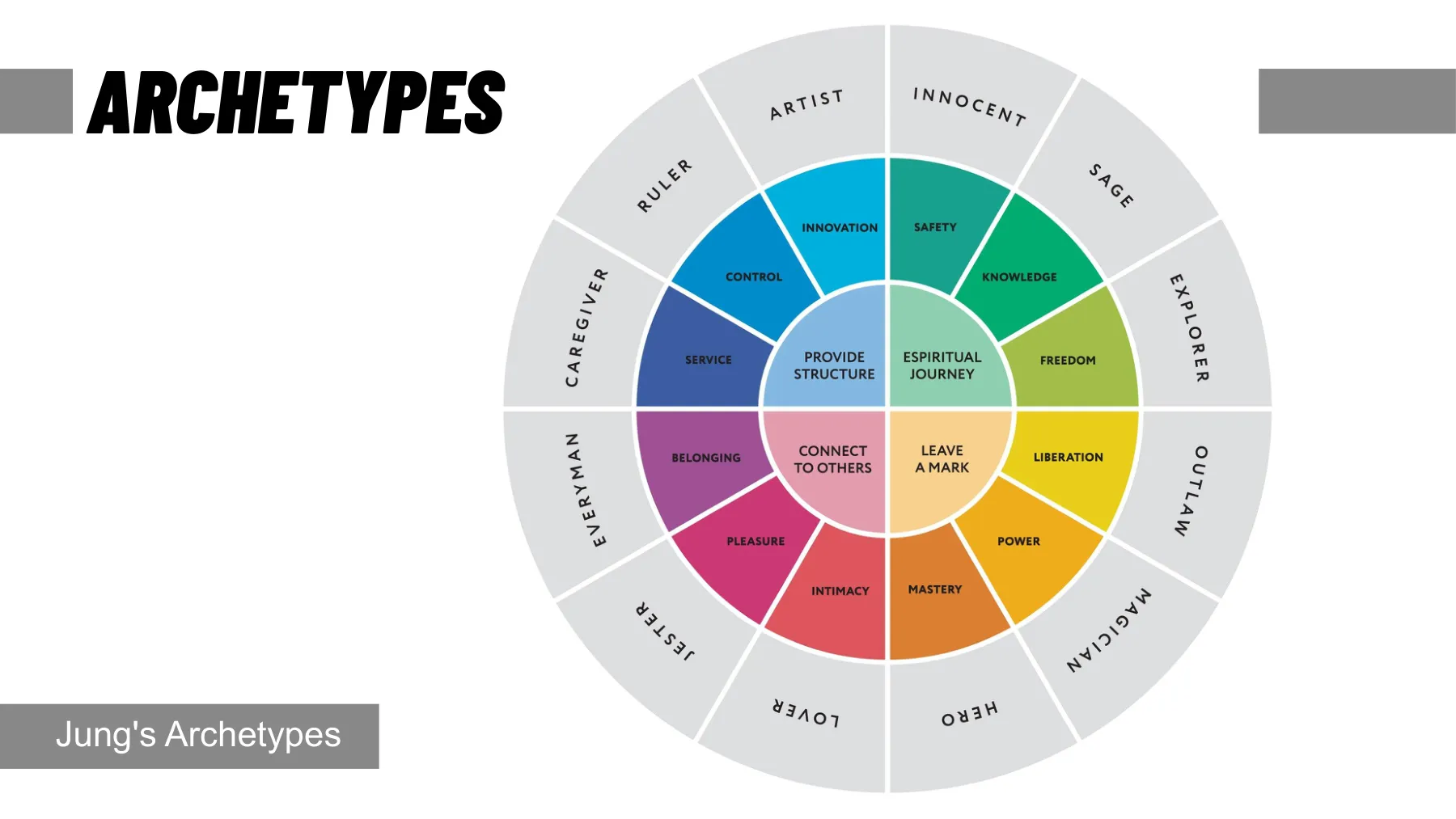
Emotion is a decision-making mechanism, not a malfunction of it: System 2 can compare options forever, but System 1 has to choose. Marketing works with this through emotional triggers; in the lecture we work with six: joy (Coca-Cola), fear and urgency (insurance, security), guilt (charity, “your kids deserve it”), pride (status, performance), belonging (club, team) and nostalgia (retro packaging, jersey comebacks).
Abraham Maslow gave marketing a framework of needs in his paper A Theory of Human Motivation (1943): physiological needs, safety, love and belonging, esteem, self-actualization; a higher need makes itself felt only once a lower one is satisfied. Two extra notes: there is no pyramid in the original paper (management textbooks drew the triangle only in the 1960s), and the order is not fixed (the starving artist exists). For marketing, the question is which need the product serves: Nike sells shoes as self-actualization, a logistics company sells logistics as safety (the goods will arrive) and esteem (the buyer chose well), a kids’ camp sells belonging.
A story carries emotion: the brain remembers plot and characters and forgets specs by lunchtime. Nike’s Dream Crazy (2018) is a story about overcoming obstacles, the Coca-Cola Christmas trucks are nostalgia, a B2B case study is the story of a customer with a problem. What spreads is high arousal (awe, humor, anger), not sadness (STEPPS). Using the IPA Effectiveness Awards database, Les Binet and Peter Field show that emotional campaigns are roughly twice as effective as rational ones and deliver twice the profit, and they recommend putting at least 60% of the budget into long-term brand building (the 60:40 ratio is covered in the Brand lesson).
Rabbit holes
- Maslow: A Theory of Human Motivation (1943) ↗ · The full text of the original paper. Read it and look for the pyramid; you won’t find it.
- Thinkbox: The Long and the Short of It (Binet and Field, IPA) ↗ · A summary of the most cited analysis of campaign effectiveness: emotion 2× more effective than rationality, at least 60% into the brand.
8ELM and AIDA through the lens of psychology: B2C vs. B2B
Two routes, one brain
- ·ELM and Kahneman: related dual-process theories, not one and the same
- ·Peripheral route: System 1 shortcuts; central route: System 2 effort, motivation and time
- ·AIDA as a rule of thumb: a filter and emotion at the top, more weighing of price and risk below
- ·B2C: one person, minutes; B2B: 5–16 people, months; emotions play a role in both
- ·Creative drives 49% of an ad’s sales effect, targeting 11% (NCS, 2023)
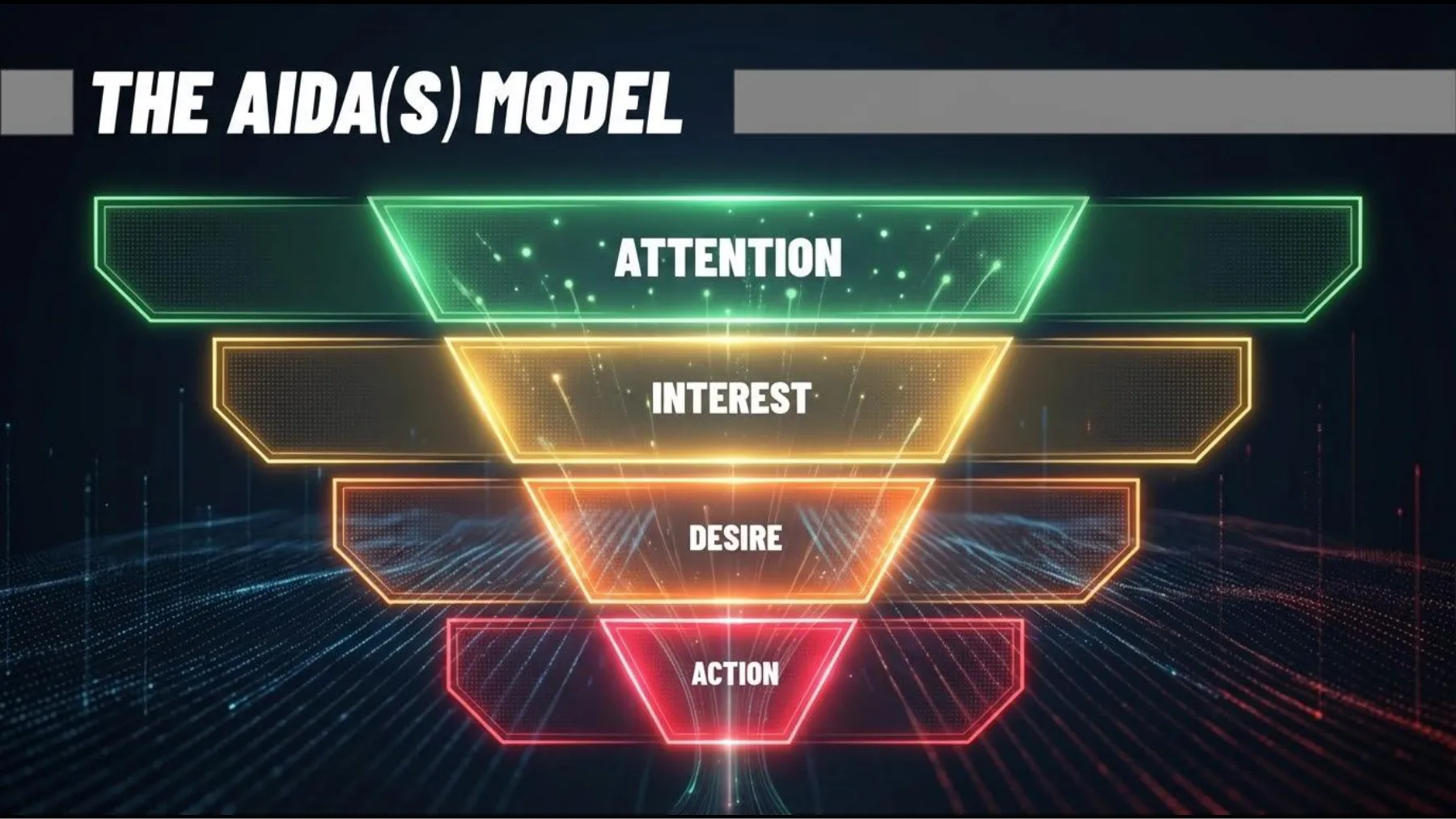
You took apart Petty and Cacioppo’s Elaboration Likelihood Model (ELM) in the Advertising lesson from the creative point of view. From the psychological point of view, ELM and Kahneman’s systems both belong to the family of dual-process theories, but they are not the same thing. ELM describes how deeply a person processes one message, and the same element can be a shortcut one time and an argument another (an attractive face is an argument for a shampoo, but only a shortcut for insurance). Kahneman describes thinking in general. What links them is that the peripheral route relies mainly on fast System 1 shortcuts (a face, music, the number of likes; an attitude forms quickly and fades quickly), while the central route takes System 2 effort (the arguments get processed, and the attitude lasts). The central route switches on only when the recipient has the motivation and the time; otherwise the peripheral one decides, whether the advertiser wants it to or not.
Through this lens, AIDA works as a rule of thumb, not a research finding. The first two steps, Attention and Interest, rest mainly on the fast “new, for me, a threat?” filter and the first emotion. Desire and Action add comparisons of price and risk, which need System 2. Feeling does not switch off even there: the decision often comes first, and reason justifies it. That is why a good product page has an image and one sentence at the top, and specs and reviews at the bottom for whoever came looking for an alibi.
The difference between B2C and B2B is not that companies decide rationally. A consumer buys a yoga mat alone in two minutes. In a company, according to Gartner (2025), the buying group has 5 to 16 people from as many as four departments, and the cycle takes months; the central route is mandatory. But each of those people has a System 1: the fear of choosing wrong and taking the blame; the pride of choosing well; fatigue from the twentieth PDF. “Nobody ever got fired for buying IBM” is loss aversion in one sentence. B2B needs emotion just as much as B2C, only a different kind: safety and esteem instead of joy and status. And creative drives 49% of an ad’s sales effect, targeting 11% (NCSolutions, 2023; a 2017 study put it at 47% and 9%, covered in detail in the Advertising lesson): even in B2B, reaching the right person is not enough.
- 49%
- of the sales effect comes from creative, targeting 11% (just under 450 campaigns)
- 2 min / months
- buying a yoga mat vs. a warehouse system: same brain, different route
NCSolutions, 2023
example from the lecture
Rabbit holes
- Wikipedia: Elaboration Likelihood Model ↗ · The two routes, what determines elaboration, how long attitudes last, and criticism of the model.
- Nielsen: When It Comes to Advertising Effectiveness, What Is Key? (2017) ↗ · The primary source: almost 500 consumer packaged goods campaigns from 2016–2017 and what made them sell.
- Westwood One: Five Keys to Advertising Effectiveness (NCSolutions) ↗ · The older NCS measurement (2017): creative is almost half of sales, reach 22%, targeting 9%, and how marketers estimate it.
- Gartner: B2B buying groups (IT-Online summary, 2025) ↗ · A survey of 632 buyers: 5 to 16 people in a group, and 74% of teams in “unhealthy conflict.”
9Personality typologies: temperaments, MBTI, Big Five, DISC
What is science and what is entertainment
- ·Temperaments (Hippocrates): choleric, sanguine, phlegmatic, melancholic
- ·MBTI: 16 types, 2 million tests a year, 39–76% get a different type after 5 weeks
- ·Big Five (OCEAN): five continuous scales, the research standard, free test also in Czech
- ·DISC: a shared language for sales teams, not a diagnostic tool
- ·In marketing: personas and psychographics, not a “customer type”
The oldest typology is the four temperaments from ancient medicine (Hippocrates, Galen): choleric, sanguine, phlegmatic and melancholic. As a customer typology: the choleric wants the result and the price right now, the melancholic wants a spreadsheet and a guarantee, the sanguine a story and people, the phlegmatic calm and time. It is not science, but it is a language for a sales conversation. The same goes for DISC (Marston, 1928: dominance, influence, steadiness, conscientiousness), a vocabulary for sales teams, not a measurement.
MBTI (Myers–Briggs Type Indicator) is the most widely used test in the world: four dichotomies (E/I, S/N, T/F, J/P), 16 types and, according to the publisher, up to 2 million tests a year. The problem is reliability: after about five weeks, 39 to 76% of people get a different type (Pittenger 1993, Schuwirth 2004, Grant 2013), because anyone close to the middle of a scale flips from one side to the other. McCrae and Costa (1989) showed that the MBTI scales correlate strongly with the Big Five (E–I with extraversion −0.74, S–N with openness 0.72): they measure the same thing, only worse and with a label. Great fun for team building, a poor basis for hiring or segmentation.
The Big Five (OCEAN: openness, conscientiousness, extraversion, agreeableness, neuroticism) is the standard in personality psychology: five continuous scales; the result holds up when the test is repeated, and it predicts behavior. The tests are free: bigfive-test.com (10 minutes, also in Czech) or the shorter IPIP. In marketing, it serves psychographic segmentation: you don’t split the audience into types; you ask what a point on a scale means for tone, channel and product. A persona then isn’t “Pavel the sanguine” but “Pavel, 34, high openness, low conscientiousness, shops at night on his phone.” In the lecture, we use four customer anchors for this (they have nothing to do with the anchor in a price list): what people pride themselves on and what the product should help them keep:
- -Physical anchor: appearance and health (fitness, cosmetics, gear).
- -Motivational anchor: values and goals (education, ecology, career).
- -Social anchor: relationships and belonging (clubs, communities).
- -Self-esteem anchor: status and recognition (premium brands, limited editions).
- -Four attitudes from the lecture: eco-conscious, visionary, hedonistic, cost-sensitive; each is a point on the Big Five scales, not a kind of person.
- 39–76%
- of people get a different MBTI type after ~5 weeks than the first time
- 2 million
- MBTI tests a year according to the publisher; an estimated 50 million people in total
- −0.74
- correlation of the MBTI E–I scale with Big Five extraversion: they measure the same thing
- 10 min
- Big Five, free and also in Czech: 120 questions, open source
Pittenger 1993, Schuwirth 2004, Grant 2013
Myers-Briggs Company via Wikipedia
McCrae and Costa, 1989
bigfive-test.com
For discussion
Take the Big Five at home (bigfive-test.com, 10 minutes) and bring five numbers. Who here knows their MBTI type? Try to predict it from your Big Five, then retake the test in a month: how many of you get different letters?
Rabbit holes
- Big Five test (free, also in Czech) ↗ · 120 questions, results on five scales with subscales, open source under the MIT license.
- Open-Source Psychometrics: IPIP Big-Five Factor Markers ↗ · A shorter version, 50 items, anonymous, with data for research.
- Wikipedia: MBTI, reliability and validity ↗ · What research says about the test and what the publisher says; test–retest numbers and correlations with the Big Five.
10Sociology: groups, tribes, trends and Dunbar’s number
People decide in groups
- ·Reference groups: aspirational, membership, dissociative
- ·Dunbar (1992): about 150 stable relationships, inner circles of 5 and 15 people
- ·2021 reanalysis: 69–109 or 16–42; it’s an estimate, not a law
- ·Trends: Rogers’ curve from the Trends lesson; each group waits for the one before it
- ·A tribe has a language, a ritual and a hero; a brand is a guest in it, not the owner
Psychology explains the individual, sociology what the individual does in a group, and buying almost always happens in a group, even when you stand at the checkout alone. There are three reference groups. Aspirational: where I want to belong (luxury, pro athletes). Membership: where I belong (a club, a company, a brand community). Dissociative: where I don’t want to belong, and its brand is dead to me (which is why teenagers leave a network once their parents show up). Every product has all three.
How many people are in those groups? In 1992, Robin Dunbar derived from the size of the primate neocortex that a human can manage about 150 stable relationships (the regression gave 148, with a 95% interval of 100 to 230), with inner layers of about 5 closest and 15 close people, who get two thirds of our social time. A 2021 reanalysis (Lindenfors, Wartel and Lind) gives 69 to 109 or 16 to 42, depending on the method: take 150 as an order of magnitude, not a constant. For marketing: the influence that counts is not reach but those 5 and 15.
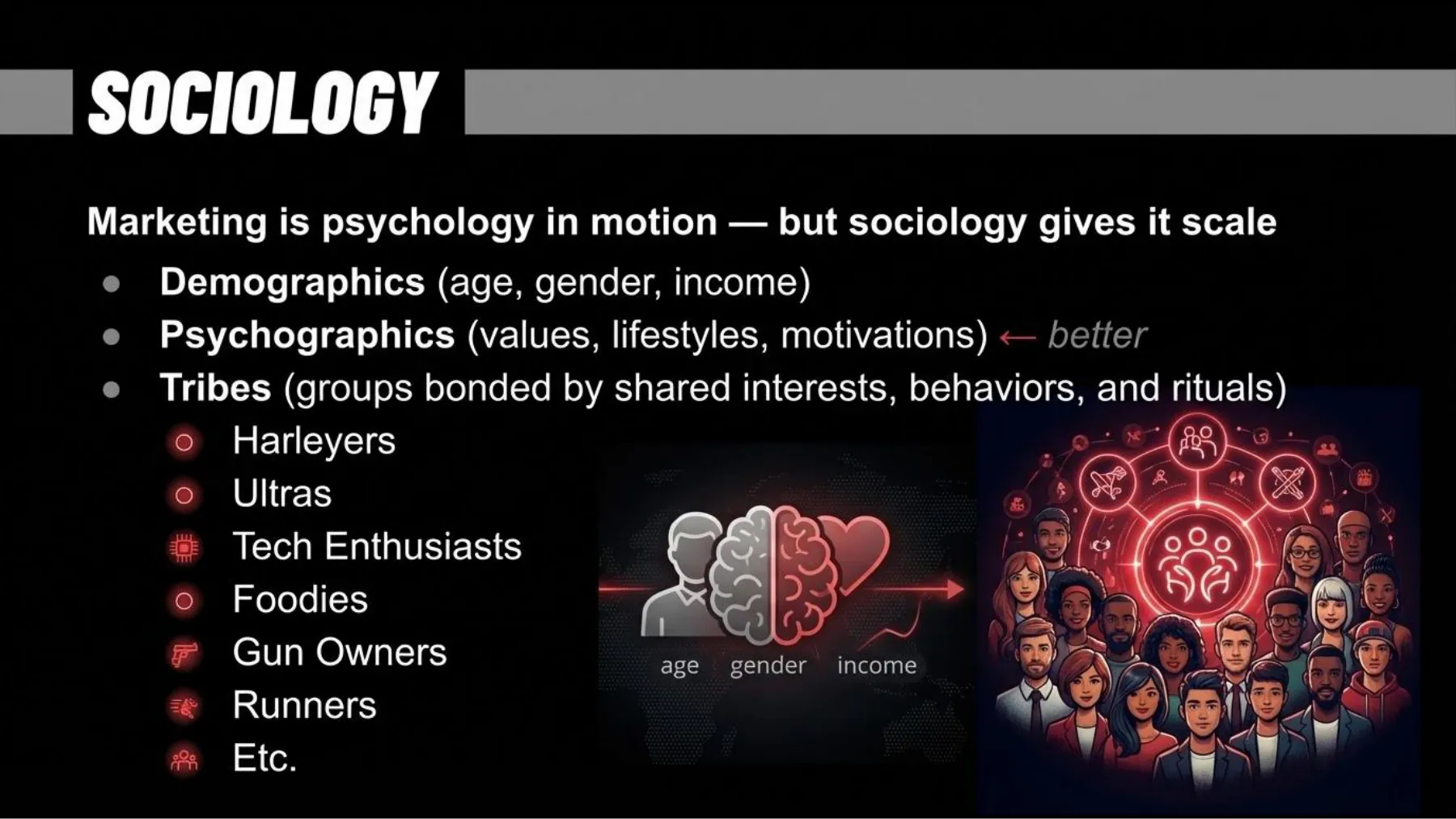
The tribes from the Social Media lesson are membership groups with their own language, ritual and hero. A brand in them is either a guest (a sponsor that respects the rules) or an intruder (a sponsor that tells the tribe what to feel); a member can tell the difference in a second, with System 1. The safest approach is to let the tribe speak for itself and just hold the camera.
The group also decides what a trend is. The bandwagon effect is social proof in motion: the more people join, the more others follow. FOMO (fear of missing out) adds loss aversion to the mix. You know Rogers’ curve of adoption (from innovators to laggards) from the Trends lesson; psychologically, what drives it is precisely social proof, because each group waits for the one before it. For a brand: jump on a trend when it fits your tribe and you are among the first; when everyone is already doing it, you are a laggard.
- 150
- stable relationships according to Dunbar (1992), 95% interval 100–230
- 5 and 15
- closest and close people: they get two thirds of our social time
- 69–109
- mean from the 2021 reanalysis (another method: 16–42): the number is an estimate
Dunbar, J. Human Evolution
Dunbar via Wikipedia
Lindenfors et al., Biology Letters 2021
Rabbit holes
- Wikipedia: Dunbar’s number ↗ · Where the number comes from, the 5/15/150 layers, use in companies, and the 2021 reanalysis.
- Wikipedia: Diffusion of innovations ↗ · Rogers’ theory: who adopts an innovation first, why, and what determines how fast it spreads.
11Appearance and first impressions
System 1 forms an opinion of you in 100 ms
- ·We judge a face in 100 ms, trustworthiness and attractiveness fastest (Todorov 2006)
- ·Halo effect: attractive = smart = kind (Thorndike 1920)
- ·Same essay: 6.7 points with an attractive author’s photo, 5.9 with an unattractive one (Landy and Sigall)
- ·Sex sells? 53 experiments: it doesn’t improve brand memory, it worsens attitudes
- ·LinkedIn, website, studio: you make a first impression before you speak
System 1 forms an opinion about a person before System 2 can do anything. Janine Willis and Alexander Todorov (Princeton, 2006) showed faces for 100 milliseconds, and judgments of trustworthiness, attractiveness, competence or aggressiveness matched judgments made with no time limit; more time mainly added confidence, while agreement with the no-limit judgments did not improve. A tenth of a second, at a job interview and in the opening shot of a video.
The second mechanism is the halo effect: one prominent trait colors all the others. In 1920, Edward Thorndike noticed that officers gave physically fit soldiers higher marks for intelligence and character too. Landy and Sigall (1974) gave men the same essay with a photo of its author: the attractive author got an average of 6.7 points out of 9, the unattractive one 5.9. For marketing: packaging, typography, photos and website speed are the product’s halo. To System 1, a slow website with a blurry logo means “unreliable company,” and one bad detail (a typo in the name, an expired certificate) drags everything down.
And what about sex sells? Robert Lull and Brad Bushman (Ohio State, 2015) summarized 53 experiments with 8,500 people over 44 years in Psychological Bulletin: sexual content in ads did not improve memory for the brand, worsened attitudes toward the brand, and did not change purchase intent. Sex draws attention to itself, not to the brand. In sports, something else works: the body as proof of performance and as aspiration, not eroticism.
- 100 ms
- is enough to judge how trustworthy a face is; more time mainly adds confidence
- 6.7 vs. 5.9
- grade for the same essay with a photo of an attractive vs. an unattractive author
- 53
- experiments in the “sex sells” meta-analysis: it doesn’t help the brand
Willis and Todorov, 2006
Landy and Sigall, 1974
Lull and Bushman, 2015
Rabbit holes
- OSU: Sex and violence may not really sell products ↗ · A summary of the meta-analysis with numbers and quotes from the authors; a link to the original study.
- Wikipedia: Halo effect ↗ · Thorndike, Dion, Landy and Sigall, photo filters: how one trait colors the others.
12Reputation and trust: social proof over time
Reputation is social proof you can’t buy all at once
- ·97% of people read reviews, 49% trust them like a recommendation from someone they know (US 2026)
- ·68% want at least 4 stars, 47% don’t trust a business with fewer than 20 reviews
- ·Trust in news in Czechia 31%, 13% pay for online news
- ·Reputation = consistency: doing what you promised, even when no one is watching
Reputation is social proof with a timeline: not what people say about you today, but what they have said over the last five years and whether it adds up. Online, it is carried by reviews. BrightLocal (2026, 1,002 adults in the US): 97% of people read reviews of local businesses, 68% want at least four stars, and the bar is rising (see the chart). In Czechia, the same role is played by Google reviews, Heureka (a Czech price-comparison site) with its “Verified by customers” badge, and Firmy.cz (a Czech business directory): the star rating is the anchor, the number of reviews is the social proof, and trust comes from the owner’s reply to a negative review.
Trust in institutions is low, and that changes whom people trust. In its Digital News Report 2026, the Reuters Institute measured trust in news in Czechia at 31% (33% the year before; the trend is in the Media lesson), and only 13% of people pay for online news. When we don’t trust institutions, we trust people: creators, reviewers, “someone like me.” So a brand’s reputation isn’t made by a press release, but by an employee on LinkedIn, a customer with a photo, and how the company responds when something goes wrong.
Psychologically, reputation is commitment and consistency stretched over time: a company that has done what it promised for five years has an anchor that one mistake won’t move; a company with no track record is judged by its latest review. So: collect reviews when satisfaction is high, reply to all of them, don’t delete the negative ones and don’t buy positive ones. A fake review is social proof turned inside out: once it is exposed, it casts doubt on the twenty genuine ones too.
What people want to see in reviews (US, 2026)
unit: %
The bar is rising: the share of people who want at least 4.5 stars nearly doubled in a year.
data table
| Read reviews of local businesses | 97% | |
|---|---|---|
| Want at least 4 stars | 68% | |
| Trust reviews as much as personal recommendations | 49% | |
| Won’t use a business with fewer than 20 reviews | 47% | |
| “Always” read reviews | 41% | 2025: 29% |
| Want at least 4.5 stars | 31% | 2025: 17% |
For discussion
Google your club, your gym or a company where you had a part-time job. How many reviews does it have, what is the average, and did anyone reply to the worst one? As the owner, what would you do tomorrow morning?
Rabbit holes
- BrightLocal: Local Consumer Review Survey 2026 ↗ · An annual survey on reviews with a trend going back to 2010: stars, volume, trust, fake reviews.
- Reuters Institute: Digital News Report 2026, Czech Republic ↗ · Trust in news, paying for news, the most trusted news brands in Czechia.
13AI and psychology: a machine that persuades
GPT-4 with your data: 81.2% higher odds that you change your mind
- ·900 people: GPT-4 with your data persuaded better than a human (Salvi 2025)
- ·Without personalization, on par with a human: the power is in the data about you
- ·AI as the marketer’s System 2: auditing biases, testing messages on personas
- ·Cialdini for millions of people at once, tailored to each one
A machine can already do everything in this lesson. In a randomized experiment, Francesco Salvi, Manoel Horta Ribeiro, Riccardo Gallotti and Robert West (EPFL, Princeton and FBK Trento) had 900 people debate either a human or GPT-4. When the model knew basic facts about its opponent (gender, age, ethnicity, education, employment, political orientation), the odds that a person would move toward the opponent’s view after the debate rose by 81.2% compared with a debate against a human. Without personalization, GPT-4 was on par with a human. The study appeared in Nature Human Behaviour (2025); the 2024 preprint reported 820 people and 81.7%. The point is not that the model is more eloquent: it can tailor Cialdini’s principles, frames and anchors to each person, at the scale of millions and for the price of tokens.
But AI can also protect attention. My dashboard from part three uses it the opposite way from social media: AI there sorts things so that as few alerts as possible come through, not as many as possible. The last sentence of the lesson: understand yourself first, then the customer. More about models in the Artificial Intelligence lesson.
- 900
- participants in a randomized experiment: human vs. GPT-4
- +81.2%
- higher odds of changing one’s mind after debating a personalized GPT-4
- 64%
- of comparisons in which personalized GPT-4 was more persuasive than a human
Salvi et al., Nature Human Behaviour 2025
Salvi et al., 2025
Salvi et al., 2025
For discussion
A model that knows your age, education and politics will persuade you more easily than a human. Where is the line for you: may an online store do this? An insurance company? A political party? And who should keep watch over it, when the customer can’t tell they are talking to a personalized machine?
Rabbit holes
- Salvi et al.: On the conversational persuasiveness of GPT-4 ↗ · The published version in Nature Human Behaviour: 900 participants, +81.2%, on par with a human without personalization.
- Preprint on arXiv (2024) ↗ · The earlier version, free: the experiment design, 820 participants, 81.7%.
For the exam
Terms
- -System 1 and System 2: fast, automatic, emotional thinking versus slow, effortful, logical thinking; most marketing speaks to System 1, and System 2 just justifies the decision.
- -Cialdini’s seven principles: reciprocity, commitment and consistency, social proof, scarcity, authority, liking and unity.
- -Dark pattern: a technique that deceives or pressures the customer (a fake countdown, a hidden price, false hierarchy); the tests of truthfulness and symmetry mark where persuasion ends.
- -Anchor, frame, decoy: the first number becomes the yardstick, the same fact described as a gain or a loss changes the choice, and an option nobody chooses changes how people see the others.
- -Big Five: five continuous personality scales (OCEAN) whose results hold when the test is repeated; unlike MBTI and temperaments, they work for personas and segmentation.
Numbers
- -2×: a loss hurts about twice as much as an equal gain pleases (prospect theory, 1979)
- -47 s: average attention on one screen before switching (Gloria Mark, UC Irvine)
- -39–76%: of people get a different MBTI type after about five weeks than the first time (Pittenger 1993, Schuwirth 2004, Grant 2013)
The final exam is online in the last lesson, in English: 30 questions with three options each from the whole course, and you need 80% to pass. It asks about the terms in the For the exam boxes and how to apply them, much like the quizzes at the end of each lesson.
Final quiz
1You’re preparing a two-hour seminar for coaches. According to the lesson, how do you structure it to hold the room’s attention?
- a)15- to 20-minute blocks with a change of format between them
- b)Two one-hour lectures with one longer break between them
- c)The most important topic at the end, once the room has warmed up
answer
a) 15- to 20-minute blocks with a change of format between themA room’s attention fluctuates just as it does on a screen, so an event is built from blocks of 15 to 20 minutes with a change of format between them (section 3)2The cookie banner on a club’s online store has a big green “Accept all” button and a small gray “Reject” link below it. How do you judge it?
- a)It’s fine: rejecting is possible, and the choice is the customer’s
- b)It fails the symmetry test: saying no is harder than saying yes
- c)It fails the truthfulness test: the banner says something untrue
answer
b) It fails the symmetry test: saying no is harder than saying yesThe symmetry test requires saying no to be as easy as saying yes, and a big green “Accept” next to a gray link is false hierarchy (section 5)3A club offers: online membership CZK 590, printed newsletter CZK 990, online + newsletter CZK 990. What role does the “printed newsletter for CZK 990” play?
- a)Anchor: the first high number other prices are measured against
- b)Loss frame: without it, customers feel they’re missing out
- c)Decoy: it won’t sell itself, but it boosts the pricier bundle
answer
c) Decoy: it won’t sell itself, but it boosts the pricier bundleA decoy is an option nobody chooses that changes how people see the others: in The Economist’s price list, it raised the pricier bundle’s share from 32% to 84% (section 6)4A federation is choosing a timing system supplier: a group of people from several departments decides, and the selection takes months. What does that mean for your offer?
- a)System 2 decides, so arguments, numbers and references are enough
- b)Reaching the right person is enough; creative is secondary in B2B
- c)Arguments for System 2, plus the emotions of safety and esteem
answer
c) Arguments for System 2, plus the emotions of safety and esteemEven in B2B, every member of the buying group has a System 1, so an offer needs the emotions of safety and esteem alongside the arguments, instead of joy and status (section 8)5A club wants to build personas for recruiting new members and needs a reliable basis. What does it start from?
- a)MBTI: 16 types that people know well and like to share
- b)Big Five: five scales whose results hold up on retest
- c)Temperaments: four types that anyone can easily remember
answer
b) Big Five: five scales whose results hold up on retestThe Big Five is the standard in personality psychology, with five continuous scales, while with MBTI, 39 to 76% of people get a different type after about five weeks (section 9)
For next time
Student presentation at the start of lesson 14 Production
Bring a poster or visual for a sports event that you think works, and one that doesn’t. Why?
5 minutes, one student or a pair, three slides at most or a phone on the projector
Sources worth clicking
- 1Daniel Kahneman: Maps of Bounded Rationality (Nobel lecture, 2002) ↗ · Primary source: Kahneman himself sums up the two systems, heuristics and prospect theory. Denser than the book, and free.
- 2Robert Cialdini: 7 Principles of Persuasion (Influence at Work) ↗ · The author’s own overview of the seven principles, including unity, with examples. A way into the book Influence.
- 3Salvi, Horta Ribeiro, Gallotti, West: On the conversational persuasiveness of GPT-4 (Nature Human Behaviour, 2025) ↗ · A randomized experiment with 900 people: GPT-4 with personal data raised the odds of changing one’s mind by 81.2%. The earlier preprint is free on arXiv (2403.14380).
- 4European Commission: Sweeps (checks of online stores, dark patterns, discounts, influencers) ↗ · Primary data: 148 of 399 online stores with a dark pattern (2022), at least 30% of retailers broke the discount rules (2025), 20% of influencers label advertising (2023).
- 5BrightLocal: Local Consumer Review Survey 2026 ↗ · An annual survey on reviews: how many people read them, how many stars they trust, how many reviews they want to see.
- 6Wikipedia: Myers–Briggs Type Indicator (reliability and validity) ↗ · The best-sourced overview of MBTI criticism: test–retest 39–76%, correlation with the Big Five, what the publisher itself says.
- 7A. H. Maslow: A Theory of Human Motivation (1943, full text) ↗ · The original paper from Psychological Review. Five needs in prose; there is no pyramid in it — management drew that only in the 1960s.
- 8Ohio State University: Sex and violence may not really sell products ↗ · A summary of the Lull and Bushman meta-analysis (2015, Psychological Bulletin): 53 experiments, 8,500 people, 44 years.
- 9Gloria Mark: Attention Span ↗ · The researcher who has measured attention on screens for twenty years: 47 seconds and falling. Book, talks, interviews.
- 10Dan Ariely: Predictably Irrational ↗ · The book with the Economist experiment (the decoy), the Social Security number as an anchor, and other experiments you can repeat in class.
Rabbit holes
- Big Five test (bigfive-test.com) ↗ · 120 questions, 10 minutes, also in Czech, free, open source under the MIT license. The only test in this lesson worth taking.
- Open-Source Psychometrics: IPIP Big-Five Factor Markers ↗ · A shorter variant: 50 items, 3 to 8 minutes, anonymous; the data go to research.
- Wikipedia: Asch conformity experiments ↗ · The 1951 experiment: 74% of people went along at least once with the majority’s obviously wrong answer. With one ally, only 5% of people still went along.
- Wikipedia: Foot-in-the-door technique ↗ · Freedman and Fraser 1966: a small request first raised agreement to a big yard sign from 17% to 76%.
- Wikipedia: Anchoring effect ↗ · The wheel of fortune, Social Security numbers, Gandhi’s age, precise vs. round house prices.
- Deceptive Design (Harry Brignull) ↗ · A catalog of dark patterns with examples and a hall of shame; by the man who coined the term dark patterns (2010).
- Reviews.org: Cell Phone Addiction Survey ↗ · 186 phone checks a day, and the trend from previous years.
- Jonathan Haidt: The Anxious Generation (2024) ↗ · A book about what phones and social media did to childhood, with proposed norms for parents and schools. Controversial, but it has influenced laws.